Tuesday, 30 November 2010

Renewable Energy: Countdown to 2020

Thanks to the lovely people at the UK Youth Climate Coalition (UKYCC), I was able to attend the Energy Institute's conference yesterday, reviewing the prospects for a renewable energy revolution in the coming decade.  My thanks also to the organisers and sponsors for a very professional and informative event.

So what are the prospects?  On balance, the speakers expressed significant doubts as to whether we will achieve the UK's target of 15% renewable energy by 2020. They made clear what the obstacles are.  Broadly, these boil down to four key areas:

  1. Complex and uncertain policies and regulatory environment.
  2. Access to the National Grid.
  3. Planning and Consent.
  4. Lack of investment due to uncompetitive returns.
The first speaker was our Minster of State for Energy, Charles Hendry, MP.  He enthused about Britain's renewable energy prospects and promised comprehensive reform of the electricity industry, including a floor price for carbon emissions, emissions performance standards (EPS), upgraded grid "interconnects" between regions and a roadmap to meet our renewables targets, all within 6 months.  Under questioning, he was unflappable but made no commitments - particularly in response to my enquiry about the level of the EPS, which he said would be decided by consultation, at a level to encourage investment in new coal and gas.  Knowing that new unabated coal power stations will be a call to arms for climate change campaigners, I am deeply concerned about the Minister's response.

Subsequent speakers exposed the holes in the current financial and regulatory frameworks.  Gemma Grimes described this as "policy soup", making investment unattractive because of the risks and uncertainty of making acceptable returns.  Most disturbing, one eloquent speaker complained that, of all our government departments, it is the Treasury that simply doesn't "get" renewable energy and the need to decarbonise our economy.  Their incomprehension is perhaps the greatest risk to our country's low carbon future.   

The shining star of the conference was Alastair Dutton from the Crown Estate, promoting massive scaling up of our offshore wind power capacity.  They are now licensing 9 "zones" in British territorial waters, where collectives of partners with different strengths will be able to establish offshore wind farms that will triple our offshore wind capacity.

The Cassandra, surprisingly, was a large-scale investor, managing £500M of pension funds.  He told us plainly that the funds needed to meet our renewable energy targets will not be available.  

I asked the panel to comment on the sustainability of liquid biofuels, used in all our transport fuels but also planned as fuel for two new power stations being developed by W4B-UK.  We were privileged to have the CEO of the Renewable Fuels Agency, Nick Goodall, to shine a spotlight on bioliquids and their carbon reduction and sustainability credentials.  A real expert in getting the details across, Nick made clear that, due to the RTFO, transport is the only area of our 2020 renewables targets that we are on track to meet.  "But not at any price", he said.   His agency's target is for 80% of biofuel to be sourced against meaningful sustainability standards: the industry's current performance is a meagre 33%.  Of the 3 billion litres of biofuel that have been burnt in Britain's fuel tanks from 2008 to date, over 250 million litres were palm oil.  Nick told me afterwards that this is just 3% of the country's consumption of palm oil and he asked wryly when Greenpeace is going to go after lipstick.  

It seems to me that the palm oil industry has aligned itself with campaigners this year, in acknowledging that production methods are unsustainable and threatening tropical biodiversity.  Is this a tactic to buy them a little more time?  My fear is that, by the time the industry implements the sustainable production standards and traceable sourcing that it now claims to want, there won't be any remaining habitat for orang-utans and all the other species clinging to life in the threatened rainforests and peatlands of Borneo and Sumatra.

In conclusion, as noted by a lawyer specialising in renewable energy finance, the low carbon economy can only be delivered by government.  My feeling is that there is a critical role for citizens and campaigners to call for decisive leadership from our government to decarbonise Britain's economy - and to make their voices heard above the siren calls for less capital-intensive fossil fuel energy capacity (that's unabated coal and gas) and more attractive returns for investors looking for 12% annual growth (nice if you can get it).

Thursday, 25 November 2010

Windsor & Eton Brewery

What an excellent evening we had last night!  Our local brewery hosted a meeting of Sustainable Windsor, with an inspiring tour of their newly-built plant and the opportunity to taste all three of their excellent, cask-conditioned ales.

The brewer, Paddy Johnson, explained many fascinating details of the brewing process, ingredient sourcing and distribution, emphasising how sustainable these processes are for a local brewer delivering cask-conditioned beers to local pubs.  From the low-energy malting of their barley to the heat-recovery systems on the copper, everything felt right about the way Paddy is crafting his beers.  Moreover, he explained that the brewery was deliberately situated in the heart of the town, in order to play a responsible part in our community.

In the Sustainable Windsor meeting that followed, Paddy once again led the way with some great suggestions for engaging local businesses and promoting sustainable activities and behaviours through regular features in the local press.  An inspiring vision for 2011 from the team that have created an exciting and successful local business in 2010.


The Two Brewers at The Two Brewers!
Willie and Paddy at the launch of their first beer on St George's Day, 2010

Monday, 22 November 2010

Sustainable Living, beyond energy

In my recent post, "The Basics Revisited", I covered the essentials of cutting carbon by saving energy at home.  Here I want to look beyond energy and explore the vast question of how to live more sustainably in our consumer society.  I can do no more than scratch the surface - whereas the film, "No Impact Man" gets uncomfortably close to the bottom of this issue!

While I am doing my best to reduce the impact of my everyday living on the environment, I remain comfortably affluent and middle-class. In discussing these matters I am aware of the risk of hypocrisy in bleating about sustainable sourcing while poverty, war and natural disasters are ravaging millions of families around the world.  My purpose in writing this is not to solve the world's problems but to offer you practical ideas and encouragement to make your life a bit greener by cutting waste and making the most of what you have.  I hope this will make you a little happier and it will also rub off on the people around you.  This article, published in the Wall Street Journal last month, compiled decades of research that demonstrates the best way to persuade other people to make ethical and environmental choices is to lead by example.  When we do what we say, practice what we preach, other people take notice.  "You must be the change that you want to see in the world" - Mahatma Gandhi.

Food and Drink
We had friends round for dinner on Saturday.  While dinner parties are not about sustainability, I was very happy with the menu we prepared.  To start, ricotta and herb-filled courgette parcels in beetroot cream (from the Montali vegetarian cookbook).  For main course, MSC-certified lemon sole with Atlantic prawn and breadcrumb gratin.  The dessert was FairTrade chocolate mousse with walnuts and cream.  Tragically, I used Divine's 85% cocoa recipe which turned the mousse rock hard.  Lesson learned!

The Lemon Sole link, above, takes you to the START initiative, which encourages us all to - yes - start doing a little to help protect our climate and the diversity of life on earth.  To buy sustainable seafood, look out for the MSC logo. Similarly, to buy products from the developing world, from bananas to coffee, sugar to cotton and roses to red wine, look out for Fair Trade.  It is often slighted as being "less good" than some other people's schemes but, honestly, it is the best across-the-board consumer signpost for ethically sourced produce.  Rarely seen in Tesco now, this is the best argument for shopping in Sainsbury's (their own-label teas and ground coffees, their bananas and their Taste the Difference jams are all fair trade) and the Co-op.

The important point is not to restrict yourself to finding only the most ethical and sustainable ingredients but rather to develop your sense of particular things to avoid.  I've been trying lately, for example, not to buy products containing palm oil that do not state it is sustainably sourced.  It is practically impossible to avoid this ubiquitous ingredient - it doesn't even have to be listed in the Ingredients Declarations! - so I'd prefer to give my business to companies that recognise the importance of sustainable sourcing.  Sainsbury's "Pure" soap and Nairns oatcakes are just two examples.  So far, I haven't found a low-fat vegetable spread that claims sustainably-sourced palm oil and I am waiting for the likes of Unilever to fix this.  Fortunately, that's exactly what they are going to do.  This week they launched their Sustainable Living Plan, committing to source ALL their ingredients sustainably within a decade. I hope they will move fast on palm oil while there are still orang-utans left to save.

More broadly, the most sustainable food is local and seasonal.  We've lost touch with the gardening year so most of us, myself included, are pretty woolly on what's in season each month.  Of course, the best remedy is to grow your own and gain a real connection with the soil.  Reading the labels to find home-grown veg at a decent price per kilo is a poor substitute but it does help to home in on seasonal produce!  Conversely, Mike Berners-Lee points out in his book, "How Bad are Bananas?" that a single kilo of organic cherry tomatoes grown in Britain in March has a carbon footprint of 50 kg CO2!  That staggering figure is the highest carbon footprint of any food.  He advises us to buy tinned tomatoes in the winter / spring, or fresh tomatoes grown in warmer climes like Spain, to avoid the intensive fossil fuel heating of greenhouse-grown crops.  While the transport impact of shipments within Europe is much smaller than heating the greenhouses, I do try to avoid fresh, perishable foods that are flown from South America - 12,000 miles away.

The golden rule of sustainable housekeeping is to plan your meals and make a list.  Buy only what's on the list, cook only as much food as needed and eat everything you prepare - leftovers make great ingredients!

Waste and Recycling
For years, the mantra of environmentalists has been "Reduce, Reuse, Recycle".  We tend to skip over the first two so let's just remember that they mean buy only what we need, make it last and, when it breaks, try to repair it or use it in another way.  Throwing things away is the last resort (and  there is no 'away') but we are all becoming accustomed to the third R, recycling.  My council (RBWM) has introduced a progressive policy of commingled recycling, with consumer vouchers to reward residents for recycling.

I find it ironic that they are aiming to maximise weight of recycled material by giving away vouchers for buying more stuff!  More serious is the fact that they will collect NO PLASTIC, other than bottles, in their doorstep recycling service.  Other packaging they consign to landfill includes aluminium foil and drinks cartons!  These exceptions are absolutely crucial and must be addressed - either by upgraded doorstep recycling or expanded "bring sites" for residents to recycle these materials.  I hope that my readers will be motivated to collect all these packaging materials and find ways to recycle them because, let's face it, the decision to send stuff to landfill is a personal one.  I refuse to send mixed plastic packaging to landfill so I am filling my garage with bags of the stuff, cleaned and ready to recycle when the Council finally recognises their duty to enable this.  Foil and cartons are much simpler (as are batteries and compact fluorescent lamps) because there are "bring sites" that I can take them to when my boxes are full.

Transport and Travel
I covered driving in a much earlier post but the key points bear repeating.  Personal transport is one of our largest sources of greenhouse gas emissions.  Nowadays, a typical car emits something like 150g CO2 per kilometre.  We drive an average of 12,000 miles a year.  Assuming we're always alone in the car, this emits  around 3 Tonnes of CO2, which is 20% of the average Briton's total of 15 Tonnes/year.

There is a great decision tool on the Start website, to help you work through the choices of whether to keep an old, inefficient car or replace it with a shiny new, low-emisisons model.  Living without a car for a couple of years taught me to view them as antisocial constructs!  Of course, we need them for commuting, shopping and holidays.  Indeed, the car is a greener choice than the plane for our summer hols but still we are poisoning our atmosphere and tarmacking our countryside to make this choice possible.  Accidents result in horrendous cost and suffering for the unlucky victims - frequently the people who chose to walk or cycle, without the protection of a steel box packed with airbags.  What is impossible to appreciate when regularly driving all over the place, for all sorts of reasons (good and bad), is how dependent we are on these machines and the freedom they provide, as they propel us wherever we wish to be on a cloud of carbon emissions from highly-refined fossil fuels.  

Ours is a genuine and complete addiction and it is not clear how we will ever break the habit.  If we can't quit then let's at least cut down a little!  With cars, like flights, it is time for us to begin weighing up whether each journey is necessary.  Our commute to work might not be optional but the school run, the quick trip to the post office or the corner shop, might be better and more enjoyable without the car.  Clean your boots, pump up your bike tyres and get outdoors!  I now walk to town for all the minor errands and only drive to the supermarket for a big shop once a week.  Even this could be ordered online, and delivered by a fuel-efficient multi-drop driver but I'm not usually that well organised.


There are endless other categories and tips but this is a blog post not a Haynes manual.  Please have a look at some of the book references in my last post - particularly Chris Goodall's comprehensive "How to live a low-carbon Life".  I would be very interested in your own suggestions so please add your comments to this page.

Thursday, 18 November 2010

Green Teams, Best Books and a Teen Movie

A big "Thank You" from me to the Centrica / British Gas Green Teams, for inviting me to open their annual Forum at the Energy Academy in Leicester today. I was given half an hour to explain why the environment, and sustainability, is so important to me - and to run through the current status of our knowledge of climate change and biodiversity. What an opportunity - and what a reception! I enjoyed meeting so many of you afterwards and discussing particular points that had caught your attention. My presentation, together with the References for each slide, will be on your intranet site and I hope you will also have my library of public-domain reports that will help you to drill down into any areas that interest you.

In my humble opinion, anybone wanting to read some particularly accessible books on climate change could do no better than these titles - available from all good bookshops!

1) "What's the Worst that could Happen" by Greg Craven, a science teacher from Oregon who posted a famous series of common-sense videos on YouTube that became the biggest hit in 2008.

2) "The Last Generation" by Fred Pearce, an immensely readable overview of the science and forecasts.

3) "The Hot Topic" by Gabrielle Walker and Sir David King, former Chief Scientist.

3) "Do good lives have to cost the Earth?" edited by Andrew Simms and Joe Smith. Essays from many famous commentators.

4) For unsurpassed insight into the demographic and political issues, with the best attempt at regulatory solutions, "Hot, Flat and Crowded" by Thomas L. Friedman was President Obama's holiday reading in 2009.

5) For the best photographs, "An Inconvenient Truth" by you know who.

6) To hear it from the horse's mouth, "Storms of my Grandchildren" by James Hansen pulls no punches.

7) To understand the global movement of our everyday goods, "Confessions of an Eco-Sinner: Travels to where my stuff comes from" by Fred Pearce is an eye-opening travelogue of the sources and sinks of modern consumer goods.

8) "How Bad are Bananas" is a light-hearted number-crunch through "the carbon footprint of everything", by Mike Berners-Lee. Mike is an unbeatable sustainability consultant - his company, Small World consulting, put together the Guardian's excellent, "Quick Carbon Calculator".

9) Lastly, the definitive guide to reducing our impact is "How to Live a Low Carbon Life" (2nd Edition) by Chris Goodall. Chris writes Carbon Commentary, which is a much better blog than this one, and his books are just about the last word in meticulously researched advice for sustainable living.

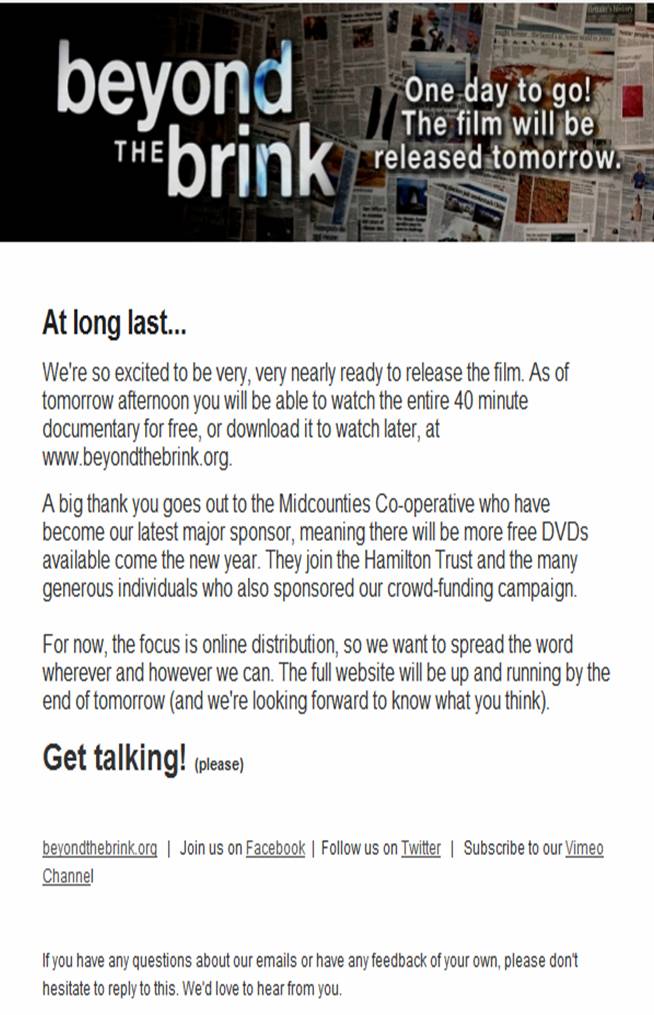
Tomorrow is a very special day for young climate campaigners.


Beyond the Brink is a young filmmaker’s take on the climate change debate. 18-year-old Ross Harrison spent a year chasing up experts, studying the news and filming to create a short documentary that answers the ever-pressing questions, Are we really causing climate change? and Who cares?

The result is a 40 minute film about the knowns and the unknowns of the science, about the risks, and about being hopeful for the future too. Interviews with Sir David Attenborough, Mark Lynas, David Shukman, Prof Dieter Helm, the UK Youth Climate Coalition, and Ross’ grandparents among others, offer fresh perspectives on a subject that saturates the media, divides the public, and yet is still meaningless to many.

At a time when people feel overloaded by hype and put off by scandals, Beyond the Brink seeks to lay out how things really stand now. Beyond the Brink is a not-for-profit production available for free for anyone to watch and use. Please let us know if you intend to screen it.

Tuesday, 2 November 2010

No Impact Man


Sustainable Windsor has teamed up with the Firestation Arts Centre to bring you the best eco-films at a discounted price. That's right, being eco-conscious really does pay off!

The first film in our eco-films promotion is No Impact Man on Thursday, November 4 at 8pm. The film tells the true-life story of Colin Beavan and his family who abandon their high-consumption New York lifestyle to try and live for a year without making any net environmental impact on the planet. That's no cars, no buses, no electricity, no rubbish.

Go here to see the trailer.

The first 25 Sustainable Windsor film lovers will get a massive 20% off the price of their tickets (normally £7.25). Just say, 'I'm with Sustainable Windsor!' when you book and you can see the film for just £5.75,

Don't worry if you haven't come to one of our fab Sustainable Windsor meetings before - you can still enjoy along to the screening and, hopefully, we'll see you at the next one!

Go to the Firestation website for more info and call 01753 866865 to book tickets or just turn up on the night.


Wednesday, 29 September 2010

The basics revisited

I've had so many people asking me for advice on saving energy, reducing emissions and consuming less in recent weeks. I do love advising people on these topics but, really, I'm delighted because it shows that many more people are becoming interested in reducing their own impact.

So here's my attempt to summarise the things that we can do to reduce our emissions from energy use at home.

I won't be able to get everything in but feel free to let me know anything important that I've missed. Other guides to the basics are available, such as this one from Tesco, but I'd recommend caution with any advice - for instance, Tesco claim that DAB digital radios save energy compared with your existing, analogue radio - the truth is precisely opposite.

Meters
Before you even start thinking about cutting your home energy use, please please PLEASE begin recording your meter readings on a regular basis! Monthly is ideal. Weekly if you're really into it, like me, or if you want to use i-measure to compare your energy and emissions with other, similar households.

If you can put your readings straight into a spreadsheet then you are well on the way to seeing exactly what benefit your energy-saving efforts are giving you. If not, just write them down in a small book or log-sheet and keep it in your meter cupboard. When you want to know how much you have saved, you'll have the all-important data to answer this question.

Heat
Our homes are responsible for over a quarter of Britain's carbon emissions while, altogether, buildings account for more than half our emissions. What works at home may well be applicable at work, in the shops or in public buildings across the country.

The biggest chunk of our home energy use in Britain goes on heating: both air (space) and water. Ultimately, this heat is all lost to the home's surroundings. Energy efficient heating involves slowing the rate at which our heat escapes, so that we can maintain a comfortable indoor temperature using less fuel and therefore less emissions.

The cheap and easy place to insulate in most houses, or top-floor flats, is your loft. I've posted lots of links to various types of loft insulation in this blog but, basically, any DIY store should have plenty of top-up insulation available at half price, or BOGOF, subsidised by the energy companies under their carbon reduction commitment. The recommended depth of loft insulation is now 275mm (call it a foot) but I've gone for 400mm over most of my loft, to make up for the storage areas where I have only got 200mm of rigid urethane foam. This works, in conjunction with reflective bubble-wrap on the rafters, to keep my water tank from freezing in winter.

Post-war houses typically have cavity walls and these need to be insulated. If yours haven't been done, you will find this an unbeatable investment - it will pay for itself in reduced energy bills in a couple of years! Older houses have solid walls, which are tougher to insulate. But all is not lost! If you're redecorating, it's the ideal opportunity to fit high-performance internal wall insulation. Although only 1 or 2 cm thick, these amazing materials can cut heat loss through your walls by as much as 25 cm of mineral wool loft insulation.

Doors and windows are, put simply, holes! To keep your warmth in, fit draught excluders to make sure that they fit securely. This is one of the cheapest DIY energy-saving methods. Nice thick curtains are great insulators and they turn south-facing windows into passive solar heaters, allowing the light and warmth in during the day but preventing it from escaping at night. Just so long as you use them.

Replacement windows and doors are much more expensive than draught excluders and curtains but replacing single-glazed windows and doors with double glazing will make your home warm and quiet and can be a good investment in maintaining the value of your home. The latest energy-efficient windows have cleverly-designed frames to prevent "thermal bridges" - parts of a building structure that conduct heat through the fabric of the building. At lower cost, secondary double glazing can be a fantastic investment and may be the only way to reduce heat loss from windows in listed buildings or conservation areas. Magneglaze polycarbonate panels fit inside your existing window-frames and are secured with magnetic strips. They cost £100-120 per square metre. They will reduce your energy bills and emissions, cut down external noise and reduce condensation. Of course, you could make your own secondary glazing - we used the ultimate cheap solution in our previous house, until we could afford to fit decent double glazing.

Other holes are responsible for heat loss as well. Chimneys, kitchen extractors, cat flaps, gaps round pipes and even air bricks. Ventilation is important but modern buildings, built to 'passivhaus' or even zero-carbon standards, are designed to be hermetically sealed. Ventilation is then provided deliberately, using ducted heat-recovery systems that bring fresh air in and pump stale, moist air out without losing its heat. I live right under the Heathrow flightpath and fitted one of these systems to my 1950s house in 2008. We have benefited in 3 ways: firstly, the energy savings from heat recovery and an airtight home (I have found and blocked up all the holes in our walls and around doors, windows and pipes). Second, clean, filtered air means less dust and smells in the house (and you should see the inlet filters when I change them every quarter). Finally, the ventilation system means that we can keep our windows closed at night and this means that we are not woken up by aeroplanes before dawn!

The last place to consider heat loss is through the floor but, as I am not prepared to raise the level of my home's floors, there is very little that I can do to cut this heat loss.

While space heating is very seasonal, we need hot water all year round. Solar water heating is a big investment (about the same as a new boiler) but it does enable you to shut down your boiler in the summer months. If you have a hot water cylinder, it pays to insulate it thoroughly - it should keep your water hot for 24 hours.

You can also save energy, and cut your emissions, by using less hot water when you shower. First, get used to turning off the shower water when you lather up. This technique is called a navy shower, and allows you to have a relaxing and effective shower while using running water for just 2 minutes in total. Second, fit a low-flow device such as this one from EAGA, available free in a government-funded energy-saving scheme.

Use your heating controls. Make sure that the hot water cylinder is fitted with a thermostat and that you set it to a lowish temperature, that is hot enough for showers / baths / washing up.
Lots of people prefer to keep their hot water "always on" which means that your heat loss from the cylinder is continuously at its worst. Instead, limit the time that the boiler runs - for both hot water and for central heating - because heating fuel consumption is, surprisingly, well correlated with running hours! It's also worthwhile replacing your room thermostat (the temperature dial) with a modern, "adaptive" thermostat. In my home, this saved 10% on the winter gas bill because it learns how your home responds to the boiler and prevents the room temperature from over-shooting and wasting fuel. Lastly, thermostatic radiator valves (TRVs) can help to reduce heating bills by limiting the temperature in bedrooms or unused rooms. They can only do this if you adjust them to meet your needs. Don't have a TRV on the radiator nearest to your room thermostat - it will prevent the room 'stat from turning the boiler off when it should.

Light
Many of my earlier entries in this blog detail how to replace inefficient lights with energy saving alternatives. The variety is bewildering so I would just say here, make a start. Don't try and do it all at once. Pick on a type of lighting in your home and try one or two replacements. When you find the energy-efficient lighting solution that you like for that type of bulb, fit it to all instances of that light in your home. When you're ready for another round, pick on another type, and so on. I started in 2006, with the SBC (small bayonet) golfball bulbs that were all around my living and dining rooms. I moved on to ceiling mounted BC (bayonet) and ES (screw) bulbs and then tackled the mains halogen bulbs called GU10s.

Next came the fluorescent striplights over the kitchen counter and the filament striplights found in our drinks cabinet and lots of bathroom lights. Replacing these with LEDs was a big win, reducing power consumption of those lights by 90%.

Lastly, the plethora of low-voltage halogen lamps that have colonised our homes in the last 10 or 20 years. It is now becoming practical to replace these with LED bulbs but to obtain equivalent brightness to the commonest halogen lamps (50 watt) remains very pricey.

Appliances
After heating and lighting, our gadgets are the biggest energy consumers in our homes. Top of the league are WET appliances - washing machine, tumble drier and dishwasher. Minimise energy wastage by running them less often, waiting until they are fully loaded, and selecting a lower temperature. Your kettle also swallows up a surprising amount of energy for such a little feller - be sure to boil only as much water as you need.

Next comes COLD appliances - fridges and freezers. Any of these over 10 or 15 years old are likely to be costing you a fortune to run. My 1990 Zanussi larder fridge got through almost 800 units of electricity (kilowatt-hours or kWh) a year: its same-sized replacement runs on just 80 kWh a year! At a cost of less than £200, this new fridge has paid for itself within 3 years.

Thirdly, entertainment and IT are using an increasing proportion of our household electricity. The proliferation of little black plugs and in-line boxes shows how many transformers we have plugged into our sockets in recent years. They ALL need to be switched off at the wall when not in use because they all (apart from the very latest, super-green phone chargers) suck power from the grid 24/7, regardless of whether or not we are using them. Remote controls like Bye Bye Standby are great for lights and home entertainments but, for all the black boxes you have around the home, the best thing to do is to hunt them down and UNPLUG them. Just plug them in when you need them and pull them out when you're done. No cost and even a bit of aerobic exercise for free!

Specifically on IT, I am writing this blog on my Fit-PC 2. This magical machine (technical term, net-top) is a small block of aluminium, about the size of two fag packets side-by-side (I don't smoke but it's the best illustration), that runs Windows just as well as my old tower PC but consumes less than 10 watts! When I got it, I expected that it would only be good for email and spreadsheets but I've come to rely on it for all my digital photos, music (I run a Squeezebox sever on it the whole time), Skype, YouTube and even BBC iPlayer! It's not quite as quick as my old PC when it comes to playing DVDs but, to be honest, I don't want to do that on my PC.

Another brilliant gadget for power saving with your computer bits is called the Intellipanel. You plug your computer and all its peripherals into the panel and, when you shut down or hibernate your computer, it kills the power to all the peripherals. It has special sockets for external hard drives, so that these don't crash if they're still running when the PC stops. You can even switch the Intellipanel off at the wall when everything's off and, when you turn it back on, it is ready to detect when you press the power button on your PC for another online session. Magic!


This post has concentrated on reducing home energy use. In my next post, I will review other aspects of sustainability in everyday life in modern Britain, such as food, recycling and travel.

Thanks for reading and don't hesitate to get in touch: either leave a comment or email cutyourcarbon (at) gmail (dot) com - this is not a clickable link because I don't want lots of spam from automated crawler bots.


Monday, 23 August 2010

Coming of age

We hosted my son's 18th birthday party at the weekend. A low-carbon occasion? Probably not. Much work went into preparing the house and garden for the influx of guests and we were so happy to be able to celebrate with most of our family and many of our friends.

Having finally completed the recycling I can confirm that we got through a fair few bottles and cans. The most important thing is that everyone enjoyed the party, particularly the birthday boy and his friends who stayed up most of the night.

I do think that our celebration had sustainability in mind, though. While we did have some gorgeous pastries made for us by Waitrose, the bulk of the catering was home-made: we enjoyed an extensive buffet (mostly vegetarian - there was no meat but we did poach a couple of salmon) and our daughter made several delightful desserts - some healthy, others less so. We had a spectacular birthday cake prepared and decorated by my wonderful Mum. Friends from the Windsor & Eton Brewery provided us with a firkin (70 pints) of "Knight of the Garter" - an irresistable, golden ale brewed within a mile of our house. Waitrose loaned us all the glasses and we borrowed cutlery and crockery from friends and family, to avoid all those disposable cups and plates. The solar garden lights and the LED spotlights in the marquee made for a great evening atmosphere. Fortunately, the only breakage of the evening was an exceedingly old deck-chair that gave up the ghost when three merry 18-year old girls tried to share it.

Although I seemed to be running the dishwasher non-stop throughout the party (about 6 "eco" cycles, I think), our annual electricity usage has slipped below 5,000 kWh for the first time today. This will help me on my way to my 10:10 target of 4,770 kWh electricity during 2010.

My other 10:10 target has been to sign up as many local people as I can. Last week, at Centrica's offices in Windsor, I was honoured and delighted to present 10:10 tags to 6 members of the Board of British Gas, all of whom pledged to sign up to the campaign. This took place during the final presentation of the Customer Panel, where we set out the challenges of our Customer Charter. I am sure that British Gas will work hard to publicise this in the autumn and they have promised to bring the Customer Panel back together some time in the spring of 2011, to tell us how they are getting on with implementing our Charter. For now, I will only say that it has been an absolute privilege to take part in the Customer Panel and I have complete confidence that British Gas have taken sustainability right to the heart of their business.