Walked through Hyde Park in the snow last night to attend this fascinating debate at the Royal Geographical Society in Exhibition Road (next to the Albert Hall). The presentations and the discussion were videoed and are available to watch online, here. Author and sustainable business advisor, Peter McManners, has published another thought-provoking take on this debate here.
Sir Stuart Rose (of M&S fame) talked about positive action from business and was credible, upbeat and sharp. He recognised that most of the hard work lies ahead and acknowledged the paradox that, right now, it's business leaders rather than consumers who are leading the transition to sustainability. When asked what can WE as individuals do to make Britain sustainable, Sir Stuart replied with admirable candour,
"Eat everything in your fridge (I eat lots of out-of-date stuff) - keep your clothes for longer (they're much tougher than you think) and use less." Good on him! The debate's chair and Guardian editor for Environment and Sustainability, Jo Confino, has reported Sir Stuart's comments in more detail here.
Hilary Benn, MP, Shadow Leader of the House of Commons and former Minister at DFID and DEFRA, took a very different tack from our nation's premier shopkeeper. He highlighted issues of unsustainable consumption in our modern world, from the inequality of food supply (1 billion overweight/obese and another billion going to bed hungry tonight) to the impoverishment of biodiversity. He noted that scaring people is bad politics and asserted that we must lead the way to sustainable lifestyles in Britain with a dream, not a nightmare. Most provocatively, Hilary told us that Government can't do things alone: radical change involves all of us. Where were the public and NGOs during the fuel price riots, he asked? The Labour government looked all round for support for their environmentally-driven fuel price escalator but found not a single voice.
Mr Benn concluded that others must show leadership, especially when the going gets tough. As you might imagine, the audience returned to this point during questioning. Rad Hart-George asked him whether the transition to renewable energy was too big for citizens to lead themselves and, if so, would the Government step up to make it happen. Benn responded with the importance of citizen-generated renewable energy through the Feed-In Tariff and Rent-a-Roof schemes. Of course, this was not intended to be a technical discussion but I didn't get the impression that the Shadow Leader of the House sees any substantial barriers to the decarbonisation of Britain's energy sector, which I found deeply troubling in the light of Monday's "Countdown to 2020" conference.
A very creative and inspiring presentation followed from Andy Hobsbawn, founder of Green Thing, the not-for-profit organisation behind the outstanding website, Do the Green Thing. Why do people queue all night to get the latest iPad but can't be bothered to switch a light off when they leave the room? These activities live in different brain areas, he said, one associated with pleasure, desire, reward and the other with admin, chores and to-do lists. Great creativity transforms things - it's a "meme-maker" and leads to insanely desirable tools for self-expression, like the iPad. Andy applies great creativity to making the simple, sustainable choices attractive - like going for a walk and turning off a lightswitch. He showed us his solutions to these challenges - they were all lovable, quirky and fun, making environmentally sustainable choices and behaviours desirable.
A "clean coal" developer asked the Panel whether his penchant for frequent air travel makes him into a "walking contradiction". In response, Hilary Benn talked of the "complex ecology of modern existence" and the interdependence that makes it hard for countries to act on their own - whereas Andy Hobsbawn said, "Think, act. Get information and then do it right. Change the people around you." In that moment, I saw where the clear vision of a sustainable future is going to come from. While business leaders will work pro-actively to make their products and services sustainable, to protect their future earnings, politicians need the likes of Andy Hobsbawn to wake up the electorate - because democratic Governments can't and won't act until their constituents demand that they do. As Mr Benn said, radical change involves all of us.
Post Script:
This 5-minute video from the American Post Carbon Institute just landed in my inbox, thanks to Eco-Tube. I think it encapsulates what Hilary Benn tried to convey in his opening remarks and I am inspired by the narrative. More creative communication than creative solutions, it makes the point that we are heading for a post-carbon future either way. By acting now, we can make it sustainable and beautiful. Do nothing and it will be ugly and terminal. Last night's debate was really about how we get this message across to people, effectively and immediately.
Showing posts with label Biodiversity. Show all posts
Showing posts with label Biodiversity. Show all posts
Thursday, 2 December 2010


Thursday, 18 November 2010
Green Teams, Best Books and a Teen Movie
A big "Thank You" from me to the Centrica / British Gas Green Teams, for inviting me to open their annual Forum at the Energy Academy in Leicester today. I was given half an hour to explain why the environment, and sustainability, is so important to me - and to run through the current status of our knowledge of climate change and biodiversity. What an opportunity - and what a reception! I enjoyed meeting so many of you afterwards and discussing particular points that had caught your attention. My presentation, together with the References for each slide, will be on your intranet site and I hope you will also have my library of public-domain reports that will help you to drill down into any areas that interest you.
In my humble opinion, anybone wanting to read some particularly accessible books on climate change could do no better than these titles - available from all good bookshops!
1) "What's the Worst that could Happen" by Greg Craven, a science teacher from Oregon who posted a famous series of common-sense videos on YouTube that became the biggest hit in 2008.
2) "The Last Generation" by Fred Pearce, an immensely readable overview of the science and forecasts.
2) "The Last Generation" by Fred Pearce, an immensely readable overview of the science and forecasts.
3) "The Hot Topic" by Gabrielle Walker and Sir David King, former Chief Scientist.
3) "Do good lives have to cost the Earth?" edited by Andrew Simms and Joe Smith. Essays from many famous commentators.
4) For unsurpassed insight into the demographic and political issues, with the best attempt at regulatory solutions, "Hot, Flat and Crowded" by Thomas L. Friedman was President Obama's holiday reading in 2009.
4) For unsurpassed insight into the demographic and political issues, with the best attempt at regulatory solutions, "Hot, Flat and Crowded" by Thomas L. Friedman was President Obama's holiday reading in 2009.
5) For the best photographs, "An Inconvenient Truth" by you know who.
6) To hear it from the horse's mouth, "Storms of my Grandchildren" by James Hansen pulls no punches.
7) To understand the global movement of our everyday goods, "Confessions of an Eco-Sinner: Travels to where my stuff comes from" by Fred Pearce is an eye-opening travelogue of the sources and sinks of modern consumer goods.
8) "How Bad are Bananas" is a light-hearted number-crunch through "the carbon footprint of everything", by Mike Berners-Lee. Mike is an unbeatable sustainability consultant - his company, Small World consulting, put together the Guardian's excellent, "Quick Carbon Calculator".
9) Lastly, the definitive guide to reducing our impact is "How to Live a Low Carbon Life" (2nd Edition) by Chris Goodall. Chris writes Carbon Commentary, which is a much better blog than this one, and his books are just about the last word in meticulously researched advice for sustainable living.
Tomorrow is a very special day for young climate campaigners.
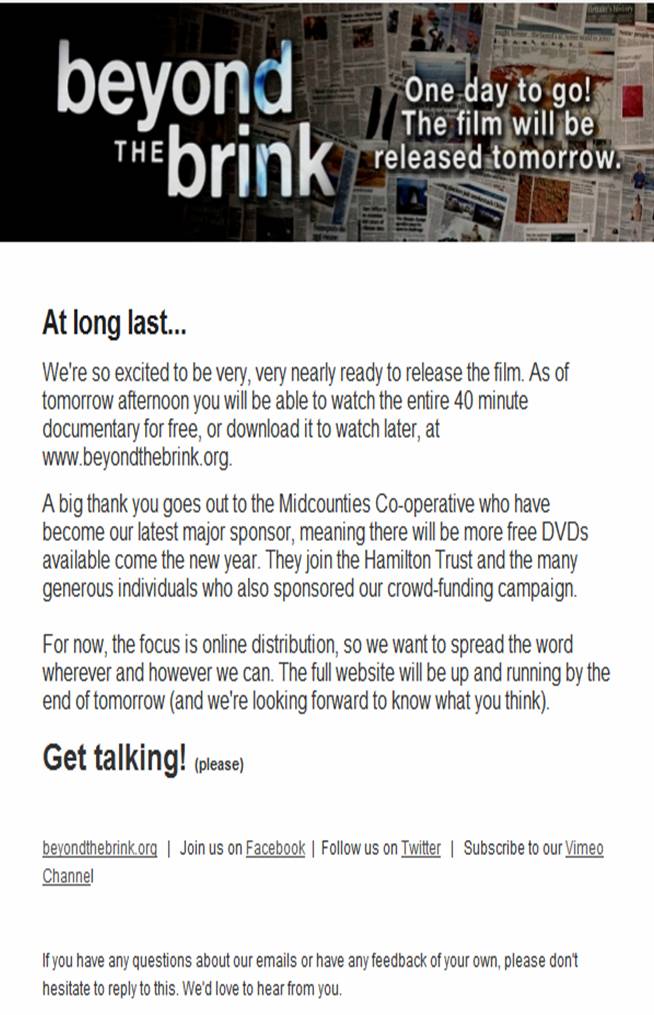
This is from www.beyondthebrink.org:
Beyond the Brink is a young filmmaker’s take on the climate change debate. 18-year-old Ross Harrison spent a year chasing up experts, studying the news and filming to create a short documentary that answers the ever-pressing questions, Are we really causing climate change? and Who cares?
The result is a 40 minute film about the knowns and the unknowns of the science, about the risks, and about being hopeful for the future too. Interviews with Sir David Attenborough, Mark Lynas, David Shukman, Prof Dieter Helm, the UK Youth Climate Coalition, and Ross’ grandparents among others, offer fresh perspectives on a subject that saturates the media, divides the public, and yet is still meaningless to many.
At a time when people feel overloaded by hype and put off by scandals, Beyond the Brink seeks to lay out how things really stand now. Beyond the Brink is a not-for-profit production available for free for anyone to watch and use. Please let us know if you intend to screen it.
Subscribe to:
Posts (Atom)
