Showing posts with label Climate Change. Show all posts

Monday, 27 February 2012

Challenging misperceptions around clean energy

Which are the greater threat, heavy metals or greenhouse gases? 

Most people are happy to agree that LED lighting is clean, efficient and the way forward - when the balance of quality, performance and price becomes acceptable for mainstream customers in our high streets and retail parks.  Until then, we can get along with the current generation of energy-saving lights, known as compact fluorescent lamps (CFLs).  In recent years they have been given away by energy companies, and sold for pennies in supermarkets, under the Government's Carbon Emissions Reductions Target (CERT) programme.  Those days are gone, however, as you will know if you have had to buy any CFLs recently - they cost anything from £2 to £6 each, which is pretty much what they should cost - they last many years and save many times their own cost in electricity over their lifetimes .

There are some downsides with CFLs:

  • they can take a long time to reach full brightness
  • their colour rendition is usually less attractive than that of old-fashioned tungsten incandescent bulbs and halogen lights
  • their brightness can fall substantially over their lifetimes
  • they contain traces of mercury and, at the end of their life, they need to be disposed of through suitable recycling facilities.
These issues have led some green campaigners to argue that we should not have banned traditional bulbs, or subsidised distribution of CFLs in recent years, because it was the wrong technology: instead, we should have waited until now - or even until 2014, when the performance and price of LED lighting will really be ready to compete with incandescent bulbs.  Their feeling is that long warm-up times and poor quality light from CFLs have turned consumers against low-energy lighting, so that the adoption of great LED lights will be held back by people's bad experiences of CFLs.  

More concerning, they oppose CFLs because of the presence of trace amounts of mercury in these bulbs.  Some bulbs will be broken in the home, exposing families to traces of mercury vapour, and many will be disposed of through household waste, potentially venting their heavy metal waste to our atmosphere or soil.  In response to this, should we all be so concerned about mercury in our CFLs that we insist on keeping our incandescent lightbulbs, stockpiling them from online retailers before they run out forever?  Well, NO.  That would be a disproportionate reaction to a misunderstood threat.

The US Environmental Protection Agency (EPA) website sets out the origins and consequences of mercury contamination, here.  The principal manmade source of mercury contamination is from burning coal.  The coal is burned in order to generate electricity, to power our homes and businesses.  In Britain today, lighting accounts for about 20% of electricity demand (source).

Here's a decent analysis of the mercury released through using a traditional, incandescent light and an energy-saving compact fluorescent lamp.  The CFL contains about 5 milligrams of mercury.  Generating the power to run it for its typical lifetime of 7,500 hours releases a further 3.5mg mercury.  That gives a maximium total mercury release of 8.5mg, if the bulb is not properly recycled when it stops working.  

How about the old-fashioned, tungsten incandescent lamp?  It will only last 1000 hours.  Powering a succession of these bulbs, with the same brightness as our CFL, for 7,500 hours will release 13 mg mercury from coal.  From this, we can conclude that (a) it's important to recycle CFLs (and all fluorescent lights) properly and (b) old-fashioned lightbulbs cause much more mercury to be released into the environment than CFLs, through their inefficient use of electricity.

Emissions of carbon dioxide and other greenhouse gases are much more significant for our future wellbeing than traces of mercury.  Dr James Hansen of NASA has written, in "Storms of my Grandchildren" (2009), that the greenhouse gases emitted from a large coal-fired power station over its operating lifespan of around 25 years will be responsible for driving 400 species to extinction, through climate change.  

CFLs have been available for about 20 years and, by using them since the mid-nineties, we have reduced emissions of both mercury and carbon dioxide from Britain's power stations.  They have been unarguably a good thing in the battle against manmade global warming.

There is no doubt that LEDs are a cleaner, greener, brighter solution for the future of lighting but they are only now beginning to challenge CFLs as the low energy lighting solution of choice, in terms of performance, quality and cost.  I have adopted LED lighting in my home as widely as I can but the great majority of my lights are compact fluorescents and I still depend on these to keep my energy bills and carbon footprint low while providing warm, welcoming lighting in almost every room of the house.  The LEDs to replace these are nowhere near competitive yet and I shall be loving my CFLs until the new lighting technology can beat them on performance, quality and total lifetime cost.  

Thursday, 13 January 2011

The first results are in ...

America's National Oceanic and Atmospheric Administration (NOAA) has just published the first analyses of global average temperatures for 2010.

Here are the 15 warmest years from 1880 to 2010
(average of global land and sea surface temperature records):
Rank         Year              Difference vs. 20th century average
1=             2005                0.62°C
1=             2010                0.62°C
3               1998                0.60°C
4=             2003                0.58°C
4=             2002                0.58°C
6=             2006                0.56°C
6=             2009                0.56°C
8               2007                0.55°C
9               2004                0.54°C
10             2001                0.52°C
11=           2008                0.48°C
11=           1997                0.48°C
13             1999                0.42°C
14             1995                0.41°C
15             2000                0.39°C
These are all in my daughter's lifetime.  How old is she?  15.

NASA have just released their analysis, confirming the ranking for the warmest 8 years on record (with a slight discrepancy between 7th and 8th place).

The Guardian reports that more analyses of the world's climate in 2010 are due later this month from the Met Office and the World  Meteorological Organisation.

Update:  Here is the Met Office data, with a handy table comparing these three data sets.  Interesting to note the difference in their reporting of temperature anomalies for these years.

Thursday, 18 November 2010

Green Teams, Best Books and a Teen Movie

A big "Thank You" from me to the Centrica / British Gas Green Teams, for inviting me to open their annual Forum at the Energy Academy in Leicester today. I was given half an hour to explain why the environment, and sustainability, is so important to me - and to run through the current status of our knowledge of climate change and biodiversity. What an opportunity - and what a reception! I enjoyed meeting so many of you afterwards and discussing particular points that had caught your attention. My presentation, together with the References for each slide, will be on your intranet site and I hope you will also have my library of public-domain reports that will help you to drill down into any areas that interest you.

In my humble opinion, anybone wanting to read some particularly accessible books on climate change could do no better than these titles - available from all good bookshops!

1) "What's the Worst that could Happen" by Greg Craven, a science teacher from Oregon who posted a famous series of common-sense videos on YouTube that became the biggest hit in 2008.

2) "The Last Generation" by Fred Pearce, an immensely readable overview of the science and forecasts.

3) "The Hot Topic" by Gabrielle Walker and Sir David King, former Chief Scientist.

3) "Do good lives have to cost the Earth?" edited by Andrew Simms and Joe Smith. Essays from many famous commentators.

4) For unsurpassed insight into the demographic and political issues, with the best attempt at regulatory solutions, "Hot, Flat and Crowded" by Thomas L. Friedman was President Obama's holiday reading in 2009.

5) For the best photographs, "An Inconvenient Truth" by you know who.

6) To hear it from the horse's mouth, "Storms of my Grandchildren" by James Hansen pulls no punches.

7) To understand the global movement of our everyday goods, "Confessions of an Eco-Sinner: Travels to where my stuff comes from" by Fred Pearce is an eye-opening travelogue of the sources and sinks of modern consumer goods.

8) "How Bad are Bananas" is a light-hearted number-crunch through "the carbon footprint of everything", by Mike Berners-Lee. Mike is an unbeatable sustainability consultant - his company, Small World consulting, put together the Guardian's excellent, "Quick Carbon Calculator".

9) Lastly, the definitive guide to reducing our impact is "How to Live a Low Carbon Life" (2nd Edition) by Chris Goodall. Chris writes Carbon Commentary, which is a much better blog than this one, and his books are just about the last word in meticulously researched advice for sustainable living.

Tomorrow is a very special day for young climate campaigners.


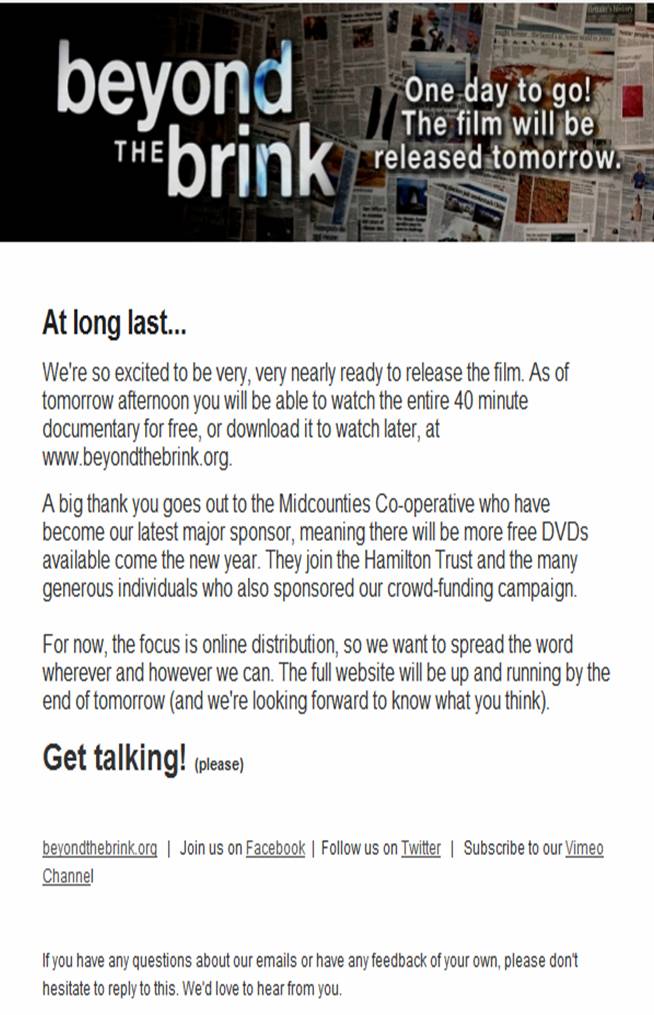
Beyond the Brink is a young filmmaker’s take on the climate change debate. 18-year-old Ross Harrison spent a year chasing up experts, studying the news and filming to create a short documentary that answers the ever-pressing questions, Are we really causing climate change? and Who cares?

The result is a 40 minute film about the knowns and the unknowns of the science, about the risks, and about being hopeful for the future too. Interviews with Sir David Attenborough, Mark Lynas, David Shukman, Prof Dieter Helm, the UK Youth Climate Coalition, and Ross’ grandparents among others, offer fresh perspectives on a subject that saturates the media, divides the public, and yet is still meaningless to many.

At a time when people feel overloaded by hype and put off by scandals, Beyond the Brink seeks to lay out how things really stand now. Beyond the Brink is a not-for-profit production available for free for anyone to watch and use. Please let us know if you intend to screen it.

Sunday, 7 March 2010

A day for 10:10

Hannah, Laura and I have been working together for a few weeks, preparing to promote the 10:10 campaign to our local community.

It was a great pleasure to visit the 10:10 office in Camden last week and meet the team who are running this amazing initiative, many of them volunteers and all of them incredibly committed to inspiring the public at large to make personal commitments to combat dangerous climate change. They kindly lent me a 2-metre high 10:10 banner and gave us lots of handouts and even the coveted 10:10 tags to sign up lots of new recruits.

Yesterday, we spent 8 hours in Waitrose, chatting about climate change and this simple pledge to cut 10% of our carbon emissions right now, in 2010. This certainly improved our sales techniques, to the point that I could now sell "The Big Issue" if things go wrong on the domestic front.

There is definitely a 'fear factor' to be overcome when talking to the public and you have just milliseconds to allay their suspicions and convince them that you're not after their money or their time and that you're not going to sell their email address to spam marketing outfits!


In our experience, many people who got as far as understanding what 10:10 means were happy to sit down at our laptop and add their name to our campaign. The only disappointment was the number of shoppers who support the idea of 10:10 but do not use email. We did keep their telephone numbers, to invite them to be part of the sustainability group that we plan to set up in our local community as a result of yesterday's promotion.

We are incredibly grateful to Waitrose for their hospitality in allowing us to talk to their customers in the comfort of the store. We are also grateful to Julian, Shaun and Theo who gave their time yesterday to catch people's eyes and charm them into hearing what 10:10 is about.

Many lovely people signed up on the spot, or went away with literature and agreed to sign up online later. Some told us that what we were doing was important and worthwhile, for which we were grateful.

A few were forthright in telling us what's really going on!

One gentleman explained that it's the human population that has gotten out of control (I'm with him so far) and that this has shifted the Earth on its axis, resulting in the climate getting hotter.

Another said that it's all these damn wars (again, nothing to disagree with to this point) and, now we've pumped all the oil out of the ground, there's nothing left to absorb the noise of all those bombs and they are warming the planet by ringing it like a bell.

Other than these contrarian theories, the only objections to the idea of 10:10 came from serving and retired cabin crew - because the town is not far from Heathrow. In the words of Upton Sinclair, quoted by Al Gore in 'An Inconvenient Truth', "It is difficult to get a man to understand something when his salary depends upon his not understanding it."

Hannah, Laura and I felt privileged to present such an important message to the people of our town and were delighted with the response we received. It was an enlightening way to spend our Saturday and will lead, we hope, to a small reduction in the town's carbon emissions.


Monday, 7 December 2009

Success in Copenhagen

On Saturday I walked through London with many, many thousands of very ordinary people of all ages, backgrounds and beliefs. We were united in our determination that the leaders of all nations, convening in Copenhagen this month, reach an ambitious, effective and fair agreement to prevent dangerous climate change.

This is the defining issue of our time, transcending politics, faith, economic status and all other divisions in society. Success in Copenhagen means rapid and effective reductions in greenhouse gas emissions from all nations. Success in Copenhagen means equitable finance for the poorest nations, most threatened by the growing dangers of an unstable climate. Success in Copenhagen means immediate and comprehensive protection for the few remaining areas of pristine rainforest, peatlands and other biodiversity hotspots around the world, on land and at sea.

Most of all, success in Copenhagen means worldwide action now, to protect the habitability of our children's world and the diversity of life that they would wish to share it with.

The Copenhagen climate conference is the most important global meeting the world has ever seen. In solidarity with all my fellow demonstrators for climate justice, I ask each of the World Leaders gathered in Copenhagen:
Open your hearts and minds to the needs of humanity and of all life on earth.
Do everything in your power to protect climate stability for future generations.
Rise to this challenge and be sure you deliver success in Copenhagen.

Our children and their children, throughout the ages to come, will thank you from the bottom of their hearts.

Monday, 16 March 2009

The Age of Stupid

I have followed the development of "Crude" and "Age of Stupid" with eager anticipation for what seems like years - well, it was years - so when I finally got to the People's Premiere in Staines last night, my expectations were sky-high.  

They were more than met.  

I was moved, challenged and inspired by this simple, haunting film.  The power in these stories and interviews is the plain, unvarnished truth of what we are doing to our species and our only home. 

The People's Premiere also featured live links to the solar tent in Leicester Square, before and after the film.  Nicholas Stern chatted with Franny on the green carpet, telling us how his 2007 Report under-estimated the costs of doing nothing and the speed with which dangerous climate change is progressing. The President of Mauritius delivered a well-spoken video contribution: to have the President of a Sovereign State announce the complete decarbonisation of a country, at this premiere, was electrifying.  Seeing Ed Miliband on stage between Franny and Mark Lynas was buttock-clenching viewing - all credit to the younger Miliband for agreeing to stand alongside them.

Franny also used the Premiere to launch the Not Stupid campaign, which everyone who sees the flim this year should be itching to join!  See their website for details - it currently has the unmissable video from the President of Mauritius:
 
At the cinema in person were Sarah from the Greening Campaign and Sam from the Campaign Against Climate Change.  They were great comperes and explained what we all need to do to influence the outcome of the critical UN climate change conference (COP15) in Copenhagen in December 2009, including getting everyone we know to join the March against Climate Change in London on 5 December.  I met Rachel Urquhart from Envision, who work to engage young people in making a difference, and was invited to a CACC co-ordination meeting at Houseman's bookshop in London on 24 March.  

This is enough of a springboard for me.  When the Not Stupid campaign are ready to release local screening licences, I will arrange one or more showing of "The Age of Stupid" in the Windsor area.  I will host one for the young people involved in Scouting and their families and am keen to arrange other evening screenings for the wider public, in our local schools. 
 
Congratulations to Franny, Lizzie, Leo, Pete Postlethwaite and all who have brought "The Age of Stupid" to our screens.  It is a brilliant film and I wish them huge success with its launch on 20 March, which is also the Spring equinox and my birthday, so a great day to start!