Thursday, 18 November 2010

Green Teams, Best Books and a Teen Movie

A big "Thank You" from me to the Centrica / British Gas Green Teams, for inviting me to open their annual Forum at the Energy Academy in Leicester today. I was given half an hour to explain why the environment, and sustainability, is so important to me - and to run through the current status of our knowledge of climate change and biodiversity. What an opportunity - and what a reception! I enjoyed meeting so many of you afterwards and discussing particular points that had caught your attention. My presentation, together with the References for each slide, will be on your intranet site and I hope you will also have my library of public-domain reports that will help you to drill down into any areas that interest you.

In my humble opinion, anybone wanting to read some particularly accessible books on climate change could do no better than these titles - available from all good bookshops!

1) "What's the Worst that could Happen" by Greg Craven, a science teacher from Oregon who posted a famous series of common-sense videos on YouTube that became the biggest hit in 2008.

2) "The Last Generation" by Fred Pearce, an immensely readable overview of the science and forecasts.

3) "The Hot Topic" by Gabrielle Walker and Sir David King, former Chief Scientist.

3) "Do good lives have to cost the Earth?" edited by Andrew Simms and Joe Smith. Essays from many famous commentators.

4) For unsurpassed insight into the demographic and political issues, with the best attempt at regulatory solutions, "Hot, Flat and Crowded" by Thomas L. Friedman was President Obama's holiday reading in 2009.

5) For the best photographs, "An Inconvenient Truth" by you know who.

6) To hear it from the horse's mouth, "Storms of my Grandchildren" by James Hansen pulls no punches.

7) To understand the global movement of our everyday goods, "Confessions of an Eco-Sinner: Travels to where my stuff comes from" by Fred Pearce is an eye-opening travelogue of the sources and sinks of modern consumer goods.

8) "How Bad are Bananas" is a light-hearted number-crunch through "the carbon footprint of everything", by Mike Berners-Lee. Mike is an unbeatable sustainability consultant - his company, Small World consulting, put together the Guardian's excellent, "Quick Carbon Calculator".

9) Lastly, the definitive guide to reducing our impact is "How to Live a Low Carbon Life" (2nd Edition) by Chris Goodall. Chris writes Carbon Commentary, which is a much better blog than this one, and his books are just about the last word in meticulously researched advice for sustainable living.

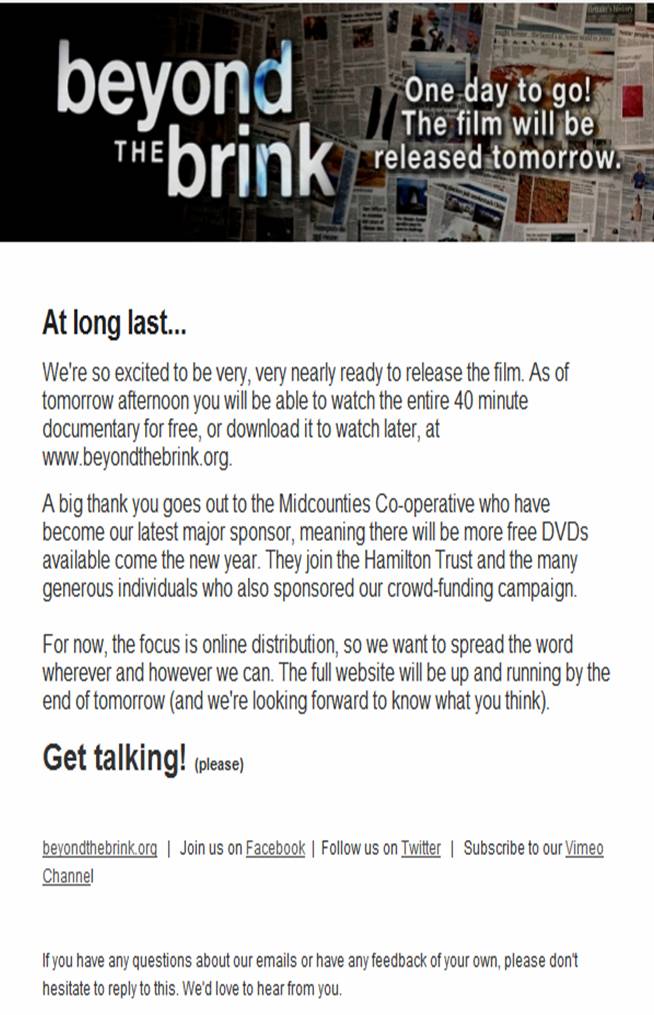
Tomorrow is a very special day for young climate campaigners.


Beyond the Brink is a young filmmaker’s take on the climate change debate. 18-year-old Ross Harrison spent a year chasing up experts, studying the news and filming to create a short documentary that answers the ever-pressing questions, Are we really causing climate change? and Who cares?

The result is a 40 minute film about the knowns and the unknowns of the science, about the risks, and about being hopeful for the future too. Interviews with Sir David Attenborough, Mark Lynas, David Shukman, Prof Dieter Helm, the UK Youth Climate Coalition, and Ross’ grandparents among others, offer fresh perspectives on a subject that saturates the media, divides the public, and yet is still meaningless to many.

At a time when people feel overloaded by hype and put off by scandals, Beyond the Brink seeks to lay out how things really stand now. Beyond the Brink is a not-for-profit production available for free for anyone to watch and use. Please let us know if you intend to screen it.

Tuesday, 2 November 2010

No Impact Man


Sustainable Windsor has teamed up with the Firestation Arts Centre to bring you the best eco-films at a discounted price. That's right, being eco-conscious really does pay off!

The first film in our eco-films promotion is No Impact Man on Thursday, November 4 at 8pm. The film tells the true-life story of Colin Beavan and his family who abandon their high-consumption New York lifestyle to try and live for a year without making any net environmental impact on the planet. That's no cars, no buses, no electricity, no rubbish.

Go here to see the trailer.

The first 25 Sustainable Windsor film lovers will get a massive 20% off the price of their tickets (normally £7.25). Just say, 'I'm with Sustainable Windsor!' when you book and you can see the film for just £5.75,

Don't worry if you haven't come to one of our fab Sustainable Windsor meetings before - you can still enjoy along to the screening and, hopefully, we'll see you at the next one!

Go to the Firestation website for more info and call 01753 866865 to book tickets or just turn up on the night.


Wednesday, 29 September 2010

The basics revisited

I've had so many people asking me for advice on saving energy, reducing emissions and consuming less in recent weeks. I do love advising people on these topics but, really, I'm delighted because it shows that many more people are becoming interested in reducing their own impact.

So here's my attempt to summarise the things that we can do to reduce our emissions from energy use at home.

I won't be able to get everything in but feel free to let me know anything important that I've missed. Other guides to the basics are available, such as this one from Tesco, but I'd recommend caution with any advice - for instance, Tesco claim that DAB digital radios save energy compared with your existing, analogue radio - the truth is precisely opposite.

Meters
Before you even start thinking about cutting your home energy use, please please PLEASE begin recording your meter readings on a regular basis! Monthly is ideal. Weekly if you're really into it, like me, or if you want to use i-measure to compare your energy and emissions with other, similar households.

If you can put your readings straight into a spreadsheet then you are well on the way to seeing exactly what benefit your energy-saving efforts are giving you. If not, just write them down in a small book or log-sheet and keep it in your meter cupboard. When you want to know how much you have saved, you'll have the all-important data to answer this question.

Heat
Our homes are responsible for over a quarter of Britain's carbon emissions while, altogether, buildings account for more than half our emissions. What works at home may well be applicable at work, in the shops or in public buildings across the country.

The biggest chunk of our home energy use in Britain goes on heating: both air (space) and water. Ultimately, this heat is all lost to the home's surroundings. Energy efficient heating involves slowing the rate at which our heat escapes, so that we can maintain a comfortable indoor temperature using less fuel and therefore less emissions.

The cheap and easy place to insulate in most houses, or top-floor flats, is your loft. I've posted lots of links to various types of loft insulation in this blog but, basically, any DIY store should have plenty of top-up insulation available at half price, or BOGOF, subsidised by the energy companies under their carbon reduction commitment. The recommended depth of loft insulation is now 275mm (call it a foot) but I've gone for 400mm over most of my loft, to make up for the storage areas where I have only got 200mm of rigid urethane foam. This works, in conjunction with reflective bubble-wrap on the rafters, to keep my water tank from freezing in winter.

Post-war houses typically have cavity walls and these need to be insulated. If yours haven't been done, you will find this an unbeatable investment - it will pay for itself in reduced energy bills in a couple of years! Older houses have solid walls, which are tougher to insulate. But all is not lost! If you're redecorating, it's the ideal opportunity to fit high-performance internal wall insulation. Although only 1 or 2 cm thick, these amazing materials can cut heat loss through your walls by as much as 25 cm of mineral wool loft insulation.

Doors and windows are, put simply, holes! To keep your warmth in, fit draught excluders to make sure that they fit securely. This is one of the cheapest DIY energy-saving methods. Nice thick curtains are great insulators and they turn south-facing windows into passive solar heaters, allowing the light and warmth in during the day but preventing it from escaping at night. Just so long as you use them.

Replacement windows and doors are much more expensive than draught excluders and curtains but replacing single-glazed windows and doors with double glazing will make your home warm and quiet and can be a good investment in maintaining the value of your home. The latest energy-efficient windows have cleverly-designed frames to prevent "thermal bridges" - parts of a building structure that conduct heat through the fabric of the building. At lower cost, secondary double glazing can be a fantastic investment and may be the only way to reduce heat loss from windows in listed buildings or conservation areas. Magneglaze polycarbonate panels fit inside your existing window-frames and are secured with magnetic strips. They cost £100-120 per square metre. They will reduce your energy bills and emissions, cut down external noise and reduce condensation. Of course, you could make your own secondary glazing - we used the ultimate cheap solution in our previous house, until we could afford to fit decent double glazing.

Other holes are responsible for heat loss as well. Chimneys, kitchen extractors, cat flaps, gaps round pipes and even air bricks. Ventilation is important but modern buildings, built to 'passivhaus' or even zero-carbon standards, are designed to be hermetically sealed. Ventilation is then provided deliberately, using ducted heat-recovery systems that bring fresh air in and pump stale, moist air out without losing its heat. I live right under the Heathrow flightpath and fitted one of these systems to my 1950s house in 2008. We have benefited in 3 ways: firstly, the energy savings from heat recovery and an airtight home (I have found and blocked up all the holes in our walls and around doors, windows and pipes). Second, clean, filtered air means less dust and smells in the house (and you should see the inlet filters when I change them every quarter). Finally, the ventilation system means that we can keep our windows closed at night and this means that we are not woken up by aeroplanes before dawn!

The last place to consider heat loss is through the floor but, as I am not prepared to raise the level of my home's floors, there is very little that I can do to cut this heat loss.

While space heating is very seasonal, we need hot water all year round. Solar water heating is a big investment (about the same as a new boiler) but it does enable you to shut down your boiler in the summer months. If you have a hot water cylinder, it pays to insulate it thoroughly - it should keep your water hot for 24 hours.

You can also save energy, and cut your emissions, by using less hot water when you shower. First, get used to turning off the shower water when you lather up. This technique is called a navy shower, and allows you to have a relaxing and effective shower while using running water for just 2 minutes in total. Second, fit a low-flow device such as this one from EAGA, available free in a government-funded energy-saving scheme.

Use your heating controls. Make sure that the hot water cylinder is fitted with a thermostat and that you set it to a lowish temperature, that is hot enough for showers / baths / washing up.
Lots of people prefer to keep their hot water "always on" which means that your heat loss from the cylinder is continuously at its worst. Instead, limit the time that the boiler runs - for both hot water and for central heating - because heating fuel consumption is, surprisingly, well correlated with running hours! It's also worthwhile replacing your room thermostat (the temperature dial) with a modern, "adaptive" thermostat. In my home, this saved 10% on the winter gas bill because it learns how your home responds to the boiler and prevents the room temperature from over-shooting and wasting fuel. Lastly, thermostatic radiator valves (TRVs) can help to reduce heating bills by limiting the temperature in bedrooms or unused rooms. They can only do this if you adjust them to meet your needs. Don't have a TRV on the radiator nearest to your room thermostat - it will prevent the room 'stat from turning the boiler off when it should.

Light
Many of my earlier entries in this blog detail how to replace inefficient lights with energy saving alternatives. The variety is bewildering so I would just say here, make a start. Don't try and do it all at once. Pick on a type of lighting in your home and try one or two replacements. When you find the energy-efficient lighting solution that you like for that type of bulb, fit it to all instances of that light in your home. When you're ready for another round, pick on another type, and so on. I started in 2006, with the SBC (small bayonet) golfball bulbs that were all around my living and dining rooms. I moved on to ceiling mounted BC (bayonet) and ES (screw) bulbs and then tackled the mains halogen bulbs called GU10s.

Next came the fluorescent striplights over the kitchen counter and the filament striplights found in our drinks cabinet and lots of bathroom lights. Replacing these with LEDs was a big win, reducing power consumption of those lights by 90%.

Lastly, the plethora of low-voltage halogen lamps that have colonised our homes in the last 10 or 20 years. It is now becoming practical to replace these with LED bulbs but to obtain equivalent brightness to the commonest halogen lamps (50 watt) remains very pricey.

Appliances
After heating and lighting, our gadgets are the biggest energy consumers in our homes. Top of the league are WET appliances - washing machine, tumble drier and dishwasher. Minimise energy wastage by running them less often, waiting until they are fully loaded, and selecting a lower temperature. Your kettle also swallows up a surprising amount of energy for such a little feller - be sure to boil only as much water as you need.

Next comes COLD appliances - fridges and freezers. Any of these over 10 or 15 years old are likely to be costing you a fortune to run. My 1990 Zanussi larder fridge got through almost 800 units of electricity (kilowatt-hours or kWh) a year: its same-sized replacement runs on just 80 kWh a year! At a cost of less than £200, this new fridge has paid for itself within 3 years.

Thirdly, entertainment and IT are using an increasing proportion of our household electricity. The proliferation of little black plugs and in-line boxes shows how many transformers we have plugged into our sockets in recent years. They ALL need to be switched off at the wall when not in use because they all (apart from the very latest, super-green phone chargers) suck power from the grid 24/7, regardless of whether or not we are using them. Remote controls like Bye Bye Standby are great for lights and home entertainments but, for all the black boxes you have around the home, the best thing to do is to hunt them down and UNPLUG them. Just plug them in when you need them and pull them out when you're done. No cost and even a bit of aerobic exercise for free!

Specifically on IT, I am writing this blog on my Fit-PC 2. This magical machine (technical term, net-top) is a small block of aluminium, about the size of two fag packets side-by-side (I don't smoke but it's the best illustration), that runs Windows just as well as my old tower PC but consumes less than 10 watts! When I got it, I expected that it would only be good for email and spreadsheets but I've come to rely on it for all my digital photos, music (I run a Squeezebox sever on it the whole time), Skype, YouTube and even BBC iPlayer! It's not quite as quick as my old PC when it comes to playing DVDs but, to be honest, I don't want to do that on my PC.

Another brilliant gadget for power saving with your computer bits is called the Intellipanel. You plug your computer and all its peripherals into the panel and, when you shut down or hibernate your computer, it kills the power to all the peripherals. It has special sockets for external hard drives, so that these don't crash if they're still running when the PC stops. You can even switch the Intellipanel off at the wall when everything's off and, when you turn it back on, it is ready to detect when you press the power button on your PC for another online session. Magic!


This post has concentrated on reducing home energy use. In my next post, I will review other aspects of sustainability in everyday life in modern Britain, such as food, recycling and travel.

Thanks for reading and don't hesitate to get in touch: either leave a comment or email cutyourcarbon (at) gmail (dot) com - this is not a clickable link because I don't want lots of spam from automated crawler bots.

Monday, 23 August 2010

Coming of age

We hosted my son's 18th birthday party at the weekend. A low-carbon occasion? Probably not. Much work went into preparing the house and garden for the influx of guests and we were so happy to be able to celebrate with most of our family and many of our friends.

Having finally completed the recycling I can confirm that we got through a fair few bottles and cans. The most important thing is that everyone enjoyed the party, particularly the birthday boy and his friends who stayed up most of the night.

I do think that our celebration had sustainability in mind, though. While we did have some gorgeous pastries made for us by Waitrose, the bulk of the catering was home-made: we enjoyed an extensive buffet (mostly vegetarian - there was no meat but we did poach a couple of salmon) and our daughter made several delightful desserts - some healthy, others less so. We had a spectacular birthday cake prepared and decorated by my wonderful Mum. Friends from the Windsor & Eton Brewery provided us with a firkin (70 pints) of "Knight of the Garter" - an irresistable, golden ale brewed within a mile of our house. Waitrose loaned us all the glasses and we borrowed cutlery and crockery from friends and family, to avoid all those disposable cups and plates. The solar garden lights and the LED spotlights in the marquee made for a great evening atmosphere. Fortunately, the only breakage of the evening was an exceedingly old deck-chair that gave up the ghost when three merry 18-year old girls tried to share it.

Although I seemed to be running the dishwasher non-stop throughout the party (about 6 "eco" cycles, I think), our annual electricity usage has slipped below 5,000 kWh for the first time today. This will help me on my way to my 10:10 target of 4,770 kWh electricity during 2010.

My other 10:10 target has been to sign up as many local people as I can. Last week, at Centrica's offices in Windsor, I was honoured and delighted to present 10:10 tags to 6 members of the Board of British Gas, all of whom pledged to sign up to the campaign. This took place during the final presentation of the Customer Panel, where we set out the challenges of our Customer Charter. I am sure that British Gas will work hard to publicise this in the autumn and they have promised to bring the Customer Panel back together some time in the spring of 2011, to tell us how they are getting on with implementing our Charter. For now, I will only say that it has been an absolute privilege to take part in the Customer Panel and I have complete confidence that British Gas have taken sustainability right to the heart of their business.

Friday, 9 July 2010

Soap Boxes

The erudite comedian David Mitchell has summed up the true position on climate change perfectly in this 3 minute Soap Box monologue. Priceless - and probably more use in spreading the word than Al Gore's Inconvenient movie. Please watch it and share it with everyone you know with a sense of humour and an open mind.

I heard another Soap Box oration yesterday afternoon, from Phil Bentley, the Managing Director of British Gas. I'm on his company's Customer Panel because I want to encourage them to promote sustainability to the 12 million households that buy energy from British Gas.

The amazing thing about Phil's address to the Customer Panel was that his strategic concerns and intentions are exactly what I would have wished them to be. He highlighted three aspects, that he called the 'eternal triangle' of energy supply:

1) Security of supply - the past winter was the the first time that Britain imported more gas than we produced. As North Sea gas supply continues to wane, our net energy imports will continue to rise so we need to act now, to diversify our energy supplies.

2) De-carbonise the energy supply - climate change will have a huge impact on society across the world and Britain is taking the lead on building our low carbon energy future.

3) Affordability of energy - British companies will spend £200Bn over the next decade, to secure energy supplies from low-carbon sources. Unfortunately, while we have the lowest unit prices for energy in the whole of Europe, our energy bills are the highest because of the low energy efficiency of much of our housing stock. British Gas focuses resources to support households that are low-income and vulnerable, these costs are shared by all its customers. Phil is happy to discuss the best solutions to improving the energy efficiency of the nation's homes with you, me and our Governement.

I suggested that these were the same requirements for our sustainable energy future that Thomas L. Friedman articulated in his book, 'Hot, Flat and Crowded', where he argues the case for clean, cheap and plentiful electrons. Phil responded emphatically that he can't deliver cheap and I am in total agreement with him that affordable is the more appropriate target.

In my view, it's because energy is so cheap today that we are willing to waste it without a second thought. Just as you can't unboil an egg, the laws of thermodynamics mean that we can't unwaste energy. All we can do, going forward, is to waste less.

Being on the Customer Panel at British Gas has given me unique insight into the company's environmental programmes and practicies. As a volunteer, with no contractual arrangements to constrain what I say, I remain fully independent and willing to criticise and praise as I see fit. I have nothing but praise for Phil's strategic intentions and hope that constructive criticism of his company's pace of change, and actions to communicate these intentions to customers and the wider public, might help them to lead the energy industry and its customers in Britain towards a more sustainable future.

Thursday, 27 May 2010

Exploring an onshore wind farm

There was a lot of discussion last week about the merits of offshore renewables, following the launch of "The Offshore Valuation", the latest report from the Public Interest Research Centre.

I agree with their findings but not with some of the interpretations of this report in the press. For example, George Monbiot argued that this work shows that onshore wind is not worthwhile in comparison with offshore wind, wave and tidal power.

Last week, I took the train from King's Cross to Aberdeen to visit the Centrica's 20-turbine wind farm in the Glens of Foudland, near Huntly. The airports were closed that morning by volcanic ash so there wasn't a spare seat to be had on the train. The plus side was that the emissions per passenger-kilometre were absolutely minimal on this journey. Actually, I was pretty confident that, during April and May, Eyjafjallajokull was responsible for more carbon emissions reductions than the wind farm I was visiting - but that's not a popular sentiment amongst our erstwhile-airborne friends and colleagues. I have to confess that the return journey, with about 30% occupancy on the train, was a lot more comfortable.

The windfarm was commissioned in April 2005 and is ideally situated at an altitude of 330m on rocky hills set in a wide, windy valley. Because of this situation, it has achieved a consistently high load factor (ie., proportion of its theoretical peak output) throughout its 5 years of operation. It is now reaching the end of its manufacturer's warranty period so there were several engineers on site, checking each of the turbines for faults and preparing to change the gearbox oil (which, I was assured, is taken away for reconditioning and reuse). With the right build quality and the appropriate level of care, these turbines will continue to generate renewable energy from free fuel for a quarter of a century.

Wind turbines are very valuable assets and their components operate under extremely high stress - just imagine the weight of a turbine blade (which can now be up to 60 metres long) turning full circle every few seconds, bolted onto a steel shaft driving a generator through a huge gearbox on top of a hollow steel tube, in a highland gale.

Now picture the same construction glued onto another 100-metre pile driven into the seabed, battered by waves and corroded by salt spray. The maintenance challenges are much more extreme than for these onshore wind turbines but the access is unimaginably difficult and expensive. So, while I agree that the longterm prospects for renewable energy from Britain's offshore territories are superb, I am certain that we need to continue erecting onshore wind turbines in suitably windy locations across the country. Britain faces energy supplies issues from the middle of the current decade and we need to be working flat out to install do-able renewable energy technologies now, at the same time as we are developing next generation renewables for the future.

The other piece of the puzzle which was written up by Jamie Bull, one of the researchers for the PIRC report, but not developed within the report, is the return on energy invested in building and maintaining renewable energy assets. Along with tidal range schemes like the lagoons proposed as a alternative to the Severn barrage, wind turbines yield the greatest return on energy invested in their manufacture, installation and maintenance. They are about three times as efficient as solar electricity panels, for example. And that goes for both onshore and offshore wind installations. So let's keep putting more wind turbines in windy places, where the load factors will be as high as possible and where the ground won't be damaged (for example, installing wind turbines on peatland dries out the precious peat, causing large-scale methane and CO2 emissions) and let's get used to their visual impact. After all, we have covered the countryside with pylons and cables for distributing electricity - let's put up with these bigger pylons that actually make it, for free!

My thanks to British Gas, for covering the costs of my rail fare and accommodation for this visit, and to Matthew Walsh, the extremely knowledgeable and able manager in charge of the operation and maintenance of Centrica's wind farms. He's one of those unknown soldiers in the fight against climate change and I take my hat off to him.

Wednesday, 5 May 2010

First "Sustainable Windsor" Newsletter

It's two weeks since we had our first meeting to launch Sustainable Windsor and we have just published the following newsletter to report all the great ideas that came out.

This new community organisation has a bright future ahead: email cutyourcarbon@gmail.com if you'd like to be added to our distribution list.


Local people form "Sustainable Windsor", a community organisation to promote sustainable living.

Sustainable Windsor, a community group inspired by the 10:10 initiative to reduce our carbon emissions by 10% in 2010 (www.1010uk.org), had its first meeting in April. We enjoyed a good turnout at The Alma pub in Springfield Road, with plenty of lively debate and many practical ideas across a range of subjects. Please feel free to pass on this newsletter to anyone you think might be interested. Details on how to get involved with Sustainable Windsor are at the end of this newsletter.

We started on waste and composting. We heard about the Composting Coach, who teaches companies how to compost their organic waste matter, and that Transco (who run the National Grid) are planning to build a huge biogas plant for London.

We talked about the "Green Point" logo, owned by Valpak, that obliges consumer goods manufacturers to fund the recycling of their packaging in Germany but not in other parts of Europe. We also recognised the missed opportunity to recycle valuable cans and bottles that are drunk "on the go" and thrown away in our high streets. We agreed on the need to campaign for on-the-go recycling points in our town.

We also liked the idea, emailed by one of our members, of collecting the red rubber bands that are dropped all over town by our dear postmen and women. We could then make them into balls and bounce them into the Post Office in Windsor for reuse, with a friendly journalist on hand to witness this simple action on litter and waste!

We learned that British business uses brown and clear glass whereas green glass is principally reused in Spain, for European wine bottles. The current trend of mixed glass recycling ends up as aggregate (replacing gravel) for surfacing roads, meaning that the UK glass industry has lost its free supply of recycled material. Waste sorting companies can readily segregate recycled glass into separate colour streams, renewing this valuable supply of clear and brown glass as raw materials for British manufacturers.

The last point on waste was mixed plastics recycling. Several of us have been fobbed off by the council, who say that collecting plastics (other than bottles) for recycling is prohibitively expensive and that there is no market for these plastics. Peter considers both these points to be false and is working with the Royal Borough's waste management team to find a solution for mixed plastics recycling in Windsor, as soon as possible.

We moved on to local food and allotments. It was noted that, although the council have long waiting lists for allotments in the Royal Borough, many of our allotments are currently lying fallow. Anne offered to contact Geoff Lane, the allotment manager in Eton Wick, to dig deeper (excuse the pun) into the reasons for this. Laura suggested that we partner up with the Windsor Allotment Society (WAGGA) to drum up more support for their summer fair and sales of produce from the allotments.

Neil proposed that we need to, "live like a village, not a town". This captures perfectly the essence of community actions for sustainable living. He suggested that we can arrange to collect all the windfall and unwanted apples across the town this summer, to make community cider. We loved this idea and will seek the help of our friends at the new Windsor & Eton Brewery.

Suzie thought we should co-opoerate with the CPRE, Civic Voice and the Civic Trust, to support our open spaces and wild areas.

Next came home energy use, looking at the latest LED lights that can replace low-voltage halogen lamps. We talked about the carbon club, called "Windsor Sustainable Living", on the imeasure website at www.imeasure.org.uk. Anyone signing up to imeasure is asked to enter their weekly energy usage, in the form of meter readings, and you can then see the emissions of CO2 per person from your house, in comparison with all the other users of the site, or with the other members of the carbon club if you decide to join. It's a great way to see how you're doing compared with like-minded people and the element of competition pushes you to turn down, switch off, and save a little more than you might otherwise do. Peter would be more than happy to offer informal, free advice to anyone wishing to reduce their home's energy use. Indeed, he was heard on Radio 4's "You and Yours" programme last week, extolling the virtues of saving energy - and money - at home. You can hear him here: http://www.bbc.co.uk/programmes/p007k260.

We then considered how to promote cycling in Windsor. Peter pointed out the little-known bye-law that permits children aged 12 and under to cycle on pavements in the town. We agreed that this should be publicised, together with the need for courtesy towards pedestrians, to encourage families to help their young children to begin cycling more safely. Hand-in-hand with more use of pavements, we recognised that the anti-social practice of parking on pavements is becoming prevalent in some parts of town and needs to be addressed pro-actively by both the council and the police. We also felt that the Windsor cycle network needs to be more integrated - particularly in the light of the major redevelopment of the Imperial Road roundabout that is due to begin shortly.

We addressed media and communication with a proposal that the Fire Station Arts Centre could screen an amazing eco-film festival this autumn, with titles such as "The Age of Stupid", "Eleventh Hour", "The End of the Line" and many more. Hannah, Laura and Neil all know Dan and the team at the Fire Station so we have a real opportunity to put together a major event in the civic calendar for Windsor, and attract a wide range of new members to join Sustainable Windsor.

Finally, we thought about education and the benefit of speaking to children at school, to engage them and their families in Sustainable Windsor. This will be more practical once we have some teachers amongst our membership, which should happen naturally as we continue to recruit local people through our initiatives and activities.

Having talked through so many topics at our first meeting, we look forward to a second meeting in a couple of months time - probably late June or early July. In the meantime, please email me your comments and suggestions on the points raised in this newsletter and any other matters you feel we could usefully cover in our next meeting.

To find out more about Sustainable Windsor or to be added to the email list, please contact cutyourcarbon@gmail.com