Mercury Falling (apologies to Sting)
You may have read Emma's incisive comment on my previous post, questioning the relevance of US mercury emissions from power generation to the safety of CFLs here in Britain. I agree! The objective of my post was to put the case that the climate change resulting from (global) greenhouse gas emissions is a much greater threat to our safety than the trace amounts of mercury present in compact fluorescent lamps. However, I used American data that didn't answer the question of how CFLs contribute to mercury pollution in Britain.
To put this right, I have examined the mercury emissions arising here in Britain from the Government's Carbon Emissions Reductions Target (CERT) programme, that funded the free distribution and subsidised retail sale of CFLs. Rightly or wrongly, I am excluding any mining and manufacturing emissions of mercury in the production of these bulbs, since that took place outside the UK.
Compact fluorescent lamps (CFLs) of up to 20 watts contain under 5 milligrams (mg) of mercury, the metal vapour that emits ultra-violet light when the bulb is running. This U-V light excites the white phosphor coating inside the tubes of the CFL, causing the phosphor to fluoresce, and that's how fluorescent lighting works, in a nutshell! The typical quantity of mercury in a modern CFL is around 4mg mercury, commonly described as "enough to cover the writing tip of a biro".
Up to 350 million compact fluorescent lamps were distributed under CERT between 2008 and 2010, containing around 1.4 Tonnes of mercury in total. Each is expected to last up to 10 years and to be recycled appropriately at end of life - in which case there is no mercury leakage from CFLs. In practice, some of these lamps break and many are thrown in the bin when they stop working, releasing their trace of mercury to the environment.
To estimate the release of mercury from these 350 million CFLs, I have assumed that (1) 10% of them fail each year, for 10 years, giving an average working life of 5 years, and (2) HALF these CFLs are broken or binned, rather than being recycled properly. In this case, 17.5 million of those CFLs supplied under CERT will be broken each year, for 10 years, releasing around 70 kg of mercury a year to the environment.
How does this compare with other sources of mercury emissions here in the UK? The 2009 National Atmospheric Emissions Inventory shows that 7.35 Tonnes of mercury were reported to be released in that year. Some of the sources were: 3.9 T from manufacturing and chemical industries, 1.5 T from cremation and clinical waste incineration, 1.3 Tonnes from power generation and 360kg from landfill.
So the amount of mercury released each year from the CFLs distributed under CERT represents just under one percent of the total annual emissions of this toxic metal in Britain. We are all exposed to this pollution, principally through our diets - because mercury enters the foodchain - and particularly if we eat the top marine predators like tuna and swordfish. But the quantities we ingest are minuscule and the risk they present to most of us is, frankly, trivial in comparison with the certain dangers of manmade climate change for us and our descendants.
We live in a 4-bedroom detached house. Shockingly, it has around 120 bulbs installed! I first surveyed the energy use of lighting in our home five years ago, when we had 34 energy-saving CFLs and 92 incandescent lights - including halogen lamps. We now have about 80 CFLs fitted and have replaced almost all the remaining incandescent bulbs with clean, bright LED lighting. Our electricity usage has halved over the same period, largely through fitting energy-efficient appliances including lighting.
I also have a small, medical thermometer containing mercury, that we used to put in our babies' mouths when they were unwell. The thermometer contains 2 - 3 times as much mercury as all the CFLs in my house. I am sad to say that climate change is a far greater threat to my grown-up babies' wellbeing than that thermometer ever was.
Wednesday, 29 February 2012


Monday, 27 February 2012
Challenging misperceptions around clean energy
Which are the greater threat, heavy metals or greenhouse gases?
Most people are happy to agree that LED lighting is clean, efficient and the way forward - when the balance of quality, performance and price becomes acceptable for mainstream customers in our high streets and retail parks. Until then, we can get along with the current generation of energy-saving lights, known as compact fluorescent lamps (CFLs). In recent years they have been given away by energy companies, and sold for pennies in supermarkets, under the Government's Carbon Emissions Reductions Target (CERT) programme. Those days are gone, however, as you will know if you have had to buy any CFLs recently - they cost anything from £2 to £6 each, which is pretty much what they should cost - they last many years and save many times their own cost in electricity over their lifetimes .
There are some downsides with CFLs:
Most people are happy to agree that LED lighting is clean, efficient and the way forward - when the balance of quality, performance and price becomes acceptable for mainstream customers in our high streets and retail parks. Until then, we can get along with the current generation of energy-saving lights, known as compact fluorescent lamps (CFLs). In recent years they have been given away by energy companies, and sold for pennies in supermarkets, under the Government's Carbon Emissions Reductions Target (CERT) programme. Those days are gone, however, as you will know if you have had to buy any CFLs recently - they cost anything from £2 to £6 each, which is pretty much what they should cost - they last many years and save many times their own cost in electricity over their lifetimes .
There are some downsides with CFLs:
- they can take a long time to reach full brightness
- their colour rendition is usually less attractive than that of old-fashioned tungsten incandescent bulbs and halogen lights
- their brightness can fall substantially over their lifetimes
- they contain traces of mercury and, at the end of their life, they need to be disposed of through suitable recycling facilities.
These issues have led some green campaigners to argue that we should not have banned traditional bulbs, or subsidised distribution of CFLs in recent years, because it was the wrong technology: instead, we should have waited until now - or even until 2014, when the performance and price of LED lighting will really be ready to compete with incandescent bulbs. Their feeling is that long warm-up times and poor quality light from CFLs have turned consumers against low-energy lighting, so that the adoption of great LED lights will be held back by people's bad experiences of CFLs.
More concerning, they oppose CFLs because of the presence of trace amounts of mercury in these bulbs. Some bulbs will be broken in the home, exposing families to traces of mercury vapour, and many will be disposed of through household waste, potentially venting their heavy metal waste to our atmosphere or soil. In response to this, should we all be so concerned about mercury in our CFLs that we insist on keeping our incandescent lightbulbs, stockpiling them from online retailers before they run out forever? Well, NO. That would be a disproportionate reaction to a misunderstood threat.
The US Environmental Protection Agency (EPA) website sets out the origins and consequences of mercury contamination, here. The principal manmade source of mercury contamination is from burning coal. The coal is burned in order to generate electricity, to power our homes and businesses. In Britain today, lighting accounts for about 20% of electricity demand (source).
Here's a decent analysis of the mercury released through using a traditional, incandescent light and an energy-saving compact fluorescent lamp. The CFL contains about 5 milligrams of mercury. Generating the power to run it for its typical lifetime of 7,500 hours releases a further 3.5mg mercury. That gives a maximium total mercury release of 8.5mg, if the bulb is not properly recycled when it stops working.
How about the old-fashioned, tungsten incandescent lamp? It will only last 1000 hours. Powering a succession of these bulbs, with the same brightness as our CFL, for 7,500 hours will release 13 mg mercury from coal. From this, we can conclude that (a) it's important to recycle CFLs (and all fluorescent lights) properly and (b) old-fashioned lightbulbs cause much more mercury to be released into the environment than CFLs, through their inefficient use of electricity.
Emissions of carbon dioxide and other greenhouse gases are much more significant for our future wellbeing than traces of mercury. Dr James Hansen of NASA has written, in "Storms of my Grandchildren" (2009), that the greenhouse gases emitted from a large coal-fired power station over its operating lifespan of around 25 years will be responsible for driving 400 species to extinction, through climate change.
CFLs have been available for about 20 years and, by using them since the mid-nineties, we have reduced emissions of both mercury and carbon dioxide from Britain's power stations. They have been unarguably a good thing in the battle against manmade global warming.
There is no doubt that LEDs are a cleaner, greener, brighter solution for the future of lighting but they are only now beginning to challenge CFLs as the low energy lighting solution of choice, in terms of performance, quality and cost. I have adopted LED lighting in my home as widely as I can but the great majority of my lights are compact fluorescents and I still depend on these to keep my energy bills and carbon footprint low while providing warm, welcoming lighting in almost every room of the house. The LEDs to replace these are nowhere near competitive yet and I shall be loving my CFLs until the new lighting technology can beat them on performance, quality and total lifetime cost.
There is no doubt that LEDs are a cleaner, greener, brighter solution for the future of lighting but they are only now beginning to challenge CFLs as the low energy lighting solution of choice, in terms of performance, quality and cost. I have adopted LED lighting in my home as widely as I can but the great majority of my lights are compact fluorescents and I still depend on these to keep my energy bills and carbon footprint low while providing warm, welcoming lighting in almost every room of the house. The LEDs to replace these are nowhere near competitive yet and I shall be loving my CFLs until the new lighting technology can beat them on performance, quality and total lifetime cost.
Tuesday, 14 February 2012
The thorny (or should that be bony?) subject of what we eat
I was recently told by a colleague that, "we were born to eat flesh". As a biologist, I would beg to differ. Our dentition, evolved from an omnivorous diet, combines cutting and grinding actions. While our canines and incisors can tear into meat, our molars enable us to chew fibrous plant material in much the same way that ruminants do. We are well adapted to a diet of fruit, vegetables and grains - supplemented with meat when we can get it. Our short alimentary canal indicates that, rather than being born to eat meat, we were born to cook. The combination of farming and fire provides plentiful calories in our diet that are much more readily absorbed than the resistant flesh of raw animal and plant tissues. Steve Jones, Professor of Genetics at University College, London, observes wryly that anyone trying to live exclusively on raw food would die of malnutrition within 90 days.
This led onto the subject of fish because my colleague felt "more strongly about the waste involved with eating fish than with cows, sheep, pigs, chicken, etc." On the day of this exchange, I happened to be cooking sea bream for dinner. Whenever we buy whole fish, I boil up the leftovers with a few vegetables and a drop of lemon juice or vinegar to produce a richly-flavoured broth. Left to chill, the broth sets to a loose jelly which forms the base for another delicious meal, such as risotto or paella. The only waste is the guts and a handful of sharp fishbones that can be composted.
Of course, there can be waste a-plenty in the supply chain. Hugh Fearnley-Whittingstall's "Fish Fight" campaign has raised our awareness of the appalling practice known as discards, where perfectly edible, dead fish are thrown back into the sea because the vessel has exceeded its fishing quotas. At the same time, Greenpeace campaigned against the use of purse-seine nets and Fish Aggregating Devices (FADs) to fish for tuna, as these methods result in carnage for other species including shark, dolphins and endangered sea turtles. This incredible campaign resulted in the immediate end to these fishing practices by all the major producers and retailers of tinned tuna.
No such consumer revolution has yet been sparked against the rape of tropical peatland rainforests in Indonesia and Malaysia, which are home to all three species of orangutan, in pursuit of the latest gold rush. Palm oil is present in about a quarter of all grocery products. It is widely used in toiletries and cosmetics. Most insidious is its inclusion, by law, as biodiesel in our transport fuel, under the Renewable Transport Fuel Obligation (RTFO). Liquid biofuels, including palm oil, produced from clearing virgin rainforest have a carbon intensity that is many times that of the fossil fuels they are intended to replace. Yet that is not stopping Eric Pickles and his Department for Communities and Local Government from granting planning consent for palm-oil fired power stations in Britain, under the deceptive claim that biofuels are a central component of Britain's plans to decarbonise our energy infrastructure in the coming decades.
Industry moves to secure sustainable supplies of palm oil, through the Round Table on Sustainable Palm Oil (RSPO) are a figleaf, however well intentioned, that is allowing the continued destruction of remaining orang-utan habitat. Most of the major retailers and brands supplying our consumer goods have pledged to use only sustainably-sourced palm oil by 2015. In the meantime, deliveries of RSPO-certified sustainable palm oil to the UK remain unsold because so few of the major players are yet prepared to take the competitive hit of paying more for this ethical ingredient while they can still get the cheap oil, whose by-product is deforestation, leading directly to gargantuan greenhouse gas emissions, biodiversity loss and the deaths of our few remaining cousins, whose name comes from the Malay language and means "people of the forest".
So what are the most sustainable and ethical foods in our diets? Allotment-holders, by their toil, earn the right to eat fresh, healthy, seasonal vegetables with no food miles whatsoever. Those of us with less time, talent and tenacity continue to depend on the supermarket for our weekly shop. The best we can do there, I believe, is to buy locally-grown food that is in season, avoiding the need for fossil fuels to heat greenhouses and to fly ripe produce to our tables from around the world. Meat and dairy products are among the most carbon-intensive foods we can buy and so it makes sense to eat less of these foods.
Instead, consider the point made by Colin Tudge in his excellent study of the history and future of food production, "So Shall we Reap" (2002). Traditional combinations of staple foods (carbohydrate-rich grains and roots) with vegetables or pulses have developed as regional cuisines around the world. The blend of proteins in each of these combinations provide all the essential amino acids we need to remain healthy. Tudge's examples include rice and tofu (bean curd) in the Far East, rice and peas in the West Indies, tortillas (maize) and frijoles (beans) in Mexico - and even baked beans on toast (wheat)! We have all experienced other, traditional combinations of carbohydrate and vegetables, from pasta and beans to potatoes and peas.
The message to take away is that meat and dairy products are not the core of a sustainable, ethical and healthy diet. That role is reserved for the rainbow varieties of peas, beans, pulses and vegetables which we can combine with our staple foods, transforming them from monotonous carbs into delicious, nutritious and aesthetic cuisine. And if there WAS a take-away serving that, I'd be the first to order a home delivery from their carbon-neutral rickshaw service!
This led onto the subject of fish because my colleague felt "more strongly about the waste involved with eating fish than with cows, sheep, pigs, chicken, etc." On the day of this exchange, I happened to be cooking sea bream for dinner. Whenever we buy whole fish, I boil up the leftovers with a few vegetables and a drop of lemon juice or vinegar to produce a richly-flavoured broth. Left to chill, the broth sets to a loose jelly which forms the base for another delicious meal, such as risotto or paella. The only waste is the guts and a handful of sharp fishbones that can be composted.
Of course, there can be waste a-plenty in the supply chain. Hugh Fearnley-Whittingstall's "Fish Fight" campaign has raised our awareness of the appalling practice known as discards, where perfectly edible, dead fish are thrown back into the sea because the vessel has exceeded its fishing quotas. At the same time, Greenpeace campaigned against the use of purse-seine nets and Fish Aggregating Devices (FADs) to fish for tuna, as these methods result in carnage for other species including shark, dolphins and endangered sea turtles. This incredible campaign resulted in the immediate end to these fishing practices by all the major producers and retailers of tinned tuna.
No such consumer revolution has yet been sparked against the rape of tropical peatland rainforests in Indonesia and Malaysia, which are home to all three species of orangutan, in pursuit of the latest gold rush. Palm oil is present in about a quarter of all grocery products. It is widely used in toiletries and cosmetics. Most insidious is its inclusion, by law, as biodiesel in our transport fuel, under the Renewable Transport Fuel Obligation (RTFO). Liquid biofuels, including palm oil, produced from clearing virgin rainforest have a carbon intensity that is many times that of the fossil fuels they are intended to replace. Yet that is not stopping Eric Pickles and his Department for Communities and Local Government from granting planning consent for palm-oil fired power stations in Britain, under the deceptive claim that biofuels are a central component of Britain's plans to decarbonise our energy infrastructure in the coming decades.
Industry moves to secure sustainable supplies of palm oil, through the Round Table on Sustainable Palm Oil (RSPO) are a figleaf, however well intentioned, that is allowing the continued destruction of remaining orang-utan habitat. Most of the major retailers and brands supplying our consumer goods have pledged to use only sustainably-sourced palm oil by 2015. In the meantime, deliveries of RSPO-certified sustainable palm oil to the UK remain unsold because so few of the major players are yet prepared to take the competitive hit of paying more for this ethical ingredient while they can still get the cheap oil, whose by-product is deforestation, leading directly to gargantuan greenhouse gas emissions, biodiversity loss and the deaths of our few remaining cousins, whose name comes from the Malay language and means "people of the forest".
So what are the most sustainable and ethical foods in our diets? Allotment-holders, by their toil, earn the right to eat fresh, healthy, seasonal vegetables with no food miles whatsoever. Those of us with less time, talent and tenacity continue to depend on the supermarket for our weekly shop. The best we can do there, I believe, is to buy locally-grown food that is in season, avoiding the need for fossil fuels to heat greenhouses and to fly ripe produce to our tables from around the world. Meat and dairy products are among the most carbon-intensive foods we can buy and so it makes sense to eat less of these foods.
Instead, consider the point made by Colin Tudge in his excellent study of the history and future of food production, "So Shall we Reap" (2002). Traditional combinations of staple foods (carbohydrate-rich grains and roots) with vegetables or pulses have developed as regional cuisines around the world. The blend of proteins in each of these combinations provide all the essential amino acids we need to remain healthy. Tudge's examples include rice and tofu (bean curd) in the Far East, rice and peas in the West Indies, tortillas (maize) and frijoles (beans) in Mexico - and even baked beans on toast (wheat)! We have all experienced other, traditional combinations of carbohydrate and vegetables, from pasta and beans to potatoes and peas.
The message to take away is that meat and dairy products are not the core of a sustainable, ethical and healthy diet. That role is reserved for the rainbow varieties of peas, beans, pulses and vegetables which we can combine with our staple foods, transforming them from monotonous carbs into delicious, nutritious and aesthetic cuisine. And if there WAS a take-away serving that, I'd be the first to order a home delivery from their carbon-neutral rickshaw service!
Friday, 27 January 2012
Why we need to use energy more sustainably
My guest blog on the British Gas Customer Newsroom website.
http://www.britishgasnewsroom.co.uk/2012/01/why-we-need-to-use-energy-more-sustainably/
Two photographs illustrate the article. The first depicts my schoolfriend, David Kidd, fitting a Navitron solar thermal heating system on my roof. He's standing safely in a long, horizontal valley between two pitched roofs so no need for a harness. The second shows the excellent downlights that I fitted into the bathroom cabinet recently, replacing 60 watts of halogen lights with 7.2 watts of warm white LED cabinet units from www.ledcentre.uk.com
http://www.britishgasnewsroom.co.uk/2012/01/why-we-need-to-use-energy-more-sustainably/
Two photographs illustrate the article. The first depicts my schoolfriend, David Kidd, fitting a Navitron solar thermal heating system on my roof. He's standing safely in a long, horizontal valley between two pitched roofs so no need for a harness. The second shows the excellent downlights that I fitted into the bathroom cabinet recently, replacing 60 watts of halogen lights with 7.2 watts of warm white LED cabinet units from www.ledcentre.uk.com
Many people argue that we can best engage the public in climate change action using positive terms, such as money to be saved, rather than evoking fear and other negative sentiments by describing the threats of unmitigated warming. A recent scholarly analysis of climate change communications by Jacqueline Stewart, of George Washington University, gives examples of effective and counter-productive attempts to communicate climate change but concludes only that success depends on the specific message, messenger and circumstances.
I believe people need to hear the truth about our situation - how can we care about something we aren't aware of? - but agree that this needs to be coupled with positive messages on what we can do about it.
This guest post is my attempt to communicate the big picture on consumption, carbon emissions and consequences, together with clear proposals for personal action to reduce all three. I am pleased that British Gas have agreed to post it on their customer website and hope that it will reach a wide audience.
Wednesday, 4 January 2012
Numbers not Adjectives
In the words of Professor David Mackay, we need "numbers, not adjectives" to compare, understand and manage our country's energy supplies and our own energy demands. In this spirit, here are two charts.
The first shows my family's energy use at home each year from 2006 to 2011. For reasons I have made clear throughout this blog, we used 52% less energy in 2011 than in 2006.

The second chart shows the costs of this energy.

Sticking to Prof. Mackay's injunction, I will simply note that, despite increases in the unit costs we pay for energy over this period, our total bill for energy in 2011 was 38% smaller than we paid in 2006.
There are all sorts of issues, from fuel poverty to carbon emissions, that this comparison does not address. The simple point that it illustrates well, however, is that individual efforts and investments to use energy more efficiently have a real impact on our energy bills. If my family had used as much energy in 2011 as we did in 2006, our bills would have risen by 17% over this period - despite switching to a cheaper supplier at the end of 2008.
And the carbon emissions from our energy use? I calculate that, in 2006, these amounted to 8 Tonnes CO2. In 2011, our annual emissions were down to 3.6 Tonnes CO2. The total reduction over five years (2007 - 11) amounts to 15.7 Tonnes.
This may not sound much compared with, for example, long-haul flights, but we haven't taken any of those in the last five years either. Cutting carbon makes each and every part of life more sustainable, from holidays to heating, from commuting to computing and from diet to DIY. Oh dear, I've forgotten the Professor's advice and slipped into rhetoric so I'd better stop and leave you to do the maths.
The first shows my family's energy use at home each year from 2006 to 2011. For reasons I have made clear throughout this blog, we used 52% less energy in 2011 than in 2006.

The second chart shows the costs of this energy.

Sticking to Prof. Mackay's injunction, I will simply note that, despite increases in the unit costs we pay for energy over this period, our total bill for energy in 2011 was 38% smaller than we paid in 2006.
There are all sorts of issues, from fuel poverty to carbon emissions, that this comparison does not address. The simple point that it illustrates well, however, is that individual efforts and investments to use energy more efficiently have a real impact on our energy bills. If my family had used as much energy in 2011 as we did in 2006, our bills would have risen by 17% over this period - despite switching to a cheaper supplier at the end of 2008.
And the carbon emissions from our energy use? I calculate that, in 2006, these amounted to 8 Tonnes CO2. In 2011, our annual emissions were down to 3.6 Tonnes CO2. The total reduction over five years (2007 - 11) amounts to 15.7 Tonnes.
This may not sound much compared with, for example, long-haul flights, but we haven't taken any of those in the last five years either. Cutting carbon makes each and every part of life more sustainable, from holidays to heating, from commuting to computing and from diet to DIY. Oh dear, I've forgotten the Professor's advice and slipped into rhetoric so I'd better stop and leave you to do the maths.
Monday, 19 December 2011
Warm winter, green Christmas and other stories
This time last year, I wrote a post for this blog called "What Colour Christmas are you Dreaming Of?"
I covered food, pressies and the merits of real vs. artificial trees. It's all still valid so I won't harp on about these things again but I just want to add this BRILLIANT picture of Christmas Past, Christmas Present and Christmas Future from Best Foot Forward!

What was most memorable about last Christmas was the weather - we had the coldest December on record in England, with snow on the ground from the beginning of the month almost until Christmas Day. This year, in southern Britain, we had such a long, warm autumn that trees were coming into bud and flowers blooming in November! Even December has hardly been cold and the Met Office have confirmed that we're in for a green Christmas.
The extreme winter of 2010 meant high consumption of gas to heat homes, with scare stories of "just 7 days supply" held in Britain. This year's mild winter has enabled my family to keep our home warm with much less gas: so much so that our consumption for 2011 is down more than 30% on 2010.

This dramatic decrease is due to weather rather than my home's efficiency or my family's behaviours relating to energy use, so should be reflected across the region. None of us know what temperatures we will face next week, next month or next year and I take no credit for the weather. However, I imagine that our country's 2011 carbon emissions will be lower than 2010, because of this climatic variation.
I have continued to cut my home's electricity usage, by replacing even more halogen lights. A couple of years ago, I replaced the fluorescent under-cabinet lights in my kitchen with LED link-lights but was left with overhead halogen lights totalling 350 watts. LED lights with the colour and brightness needed to replace 50 watt halogen downlights are now becoming available and I have fitted two Edison GU10 bulbs, each with 3 X 2 watt CREE LEDs, above the kitchen sink. Even these are not as bright as the MR16 halogens they replaced, so I am holding off on replacing the two most critical lights in the kitchen, above the oven and kitchen table.
However, the room's main illumination is a mirrored cluster of 10 watt and 20 watt halogen bulbs, totalling 150 watts. The power supply in this lamp recently burned out, giving me the opportunity to replace it with a suitable LED driver and to fit warm white LED lamps and G4 bulbs in place of the halogens. I purchased these from http://www.ledcentre.uk.com/ and they were delivered the next day - in the middle of the pre-Christmas rush.


The chrome lamp units have a really high quality feel and I am amazed that the light they provide is simply BETTER than the illumination we got from the halogen bulbs they have replaced. What is more surprising is the feeling of warmth that this bright light creates. The mirrored cluster has 12 light fittings and the whole thing now uses the same amount of electricity that a single one of the halogen bulbs used to consume! I have bought another three of these lamp units, to convert the bathroom lights from 60 watt halogen to 7 watt LED.
I worked really hard to cut my home's carbon emissions by 10% last year, to deliver my 10:10 promise, but the bitterly cold weather scuppered this for me. This year's mild winter has enabled me to reduce my home's CO2 by more than 20% which more than makes up for missing last year's target. The effects of warm weather and more efficient use of electricity have combined to save almost a Tonne of CO2 emissions from our home's energy usage in 2011 (3.6 Tonnes), compared with 2010 (4.6 Tonnes).
I covered food, pressies and the merits of real vs. artificial trees. It's all still valid so I won't harp on about these things again but I just want to add this BRILLIANT picture of Christmas Past, Christmas Present and Christmas Future from Best Foot Forward!

What was most memorable about last Christmas was the weather - we had the coldest December on record in England, with snow on the ground from the beginning of the month almost until Christmas Day. This year, in southern Britain, we had such a long, warm autumn that trees were coming into bud and flowers blooming in November! Even December has hardly been cold and the Met Office have confirmed that we're in for a green Christmas.
The extreme winter of 2010 meant high consumption of gas to heat homes, with scare stories of "just 7 days supply" held in Britain. This year's mild winter has enabled my family to keep our home warm with much less gas: so much so that our consumption for 2011 is down more than 30% on 2010.

This dramatic decrease is due to weather rather than my home's efficiency or my family's behaviours relating to energy use, so should be reflected across the region. None of us know what temperatures we will face next week, next month or next year and I take no credit for the weather. However, I imagine that our country's 2011 carbon emissions will be lower than 2010, because of this climatic variation.
I have continued to cut my home's electricity usage, by replacing even more halogen lights. A couple of years ago, I replaced the fluorescent under-cabinet lights in my kitchen with LED link-lights but was left with overhead halogen lights totalling 350 watts. LED lights with the colour and brightness needed to replace 50 watt halogen downlights are now becoming available and I have fitted two Edison GU10 bulbs, each with 3 X 2 watt CREE LEDs, above the kitchen sink. Even these are not as bright as the MR16 halogens they replaced, so I am holding off on replacing the two most critical lights in the kitchen, above the oven and kitchen table.
However, the room's main illumination is a mirrored cluster of 10 watt and 20 watt halogen bulbs, totalling 150 watts. The power supply in this lamp recently burned out, giving me the opportunity to replace it with a suitable LED driver and to fit warm white LED lamps and G4 bulbs in place of the halogens. I purchased these from http://www.ledcentre.uk.com/ and they were delivered the next day - in the middle of the pre-Christmas rush.

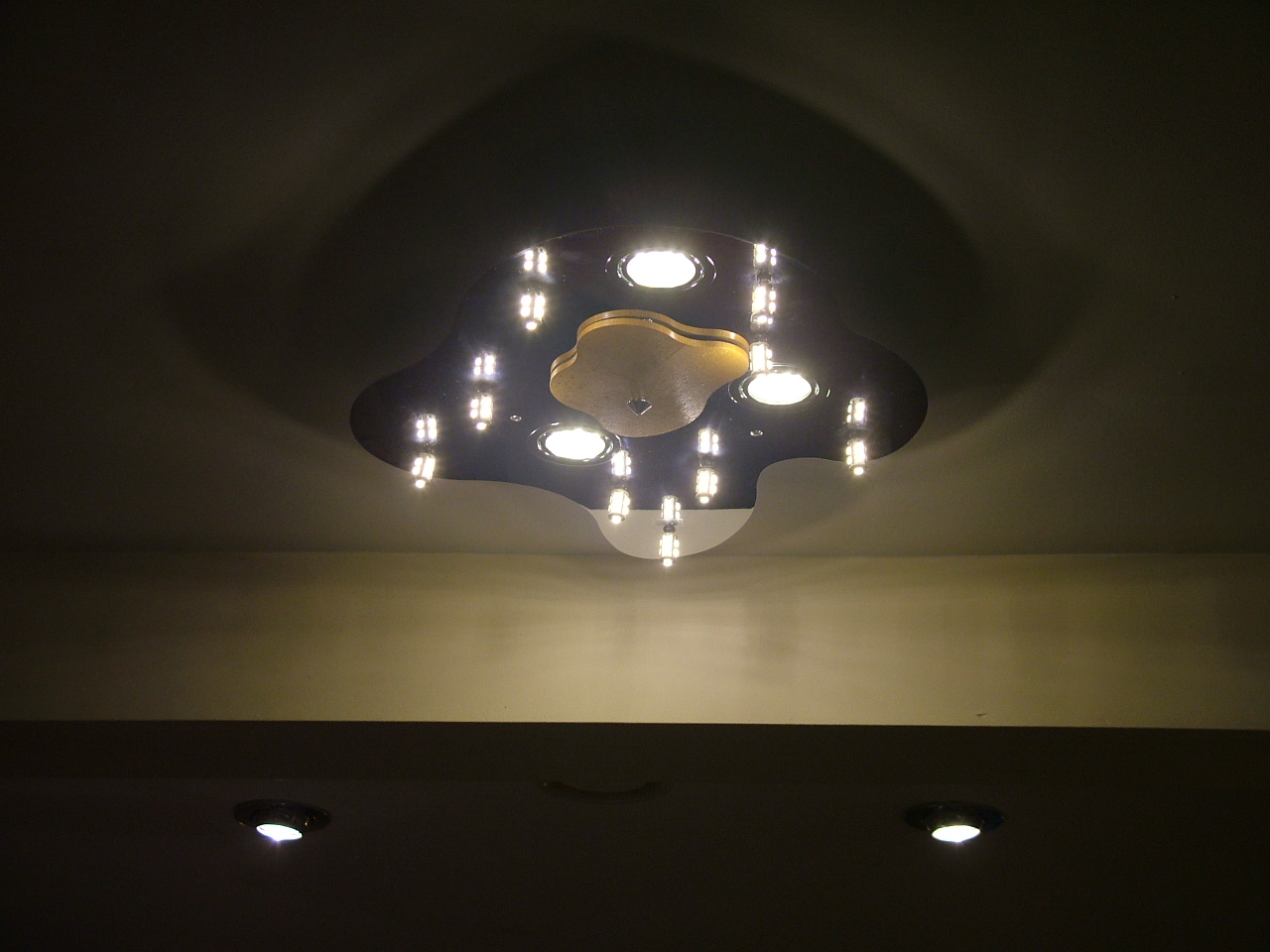
The chrome lamp units have a really high quality feel and I am amazed that the light they provide is simply BETTER than the illumination we got from the halogen bulbs they have replaced. What is more surprising is the feeling of warmth that this bright light creates. The mirrored cluster has 12 light fittings and the whole thing now uses the same amount of electricity that a single one of the halogen bulbs used to consume! I have bought another three of these lamp units, to convert the bathroom lights from 60 watt halogen to 7 watt LED.
I worked really hard to cut my home's carbon emissions by 10% last year, to deliver my 10:10 promise, but the bitterly cold weather scuppered this for me. This year's mild winter has enabled me to reduce my home's CO2 by more than 20% which more than makes up for missing last year's target. The effects of warm weather and more efficient use of electricity have combined to save almost a Tonne of CO2 emissions from our home's energy usage in 2011 (3.6 Tonnes), compared with 2010 (4.6 Tonnes).
Wednesday, 31 August 2011
Why my (or your) carbon footprint matters
At the Ashden Awards in June, I was lucky enough to meet Emma Murphy, one of the founders of the green PR outfit, Life Size Media. She combines great technical understanding of climate change mitigation with a creative flair for communicating the subject. I mention this because they are now running a poll on the question, "Do you think it's important to know your carbon footprint?" Quite apart from the audience selection bias of their followers, I suspect that very few people have a clear idea of their own carbon footprint and almost nobody can be sure of their own direct and indirect contribution to humanity's greenhouse gas emissions, the scale of which is illustrated beautifully by a post on Karina Rubiera's blog:

Here are some of the confusing carbon emissions measurements that I have come across today:
1) My local leisure centre used 6 million kWh of gas last year and its carbon emissions were almost 1500 Tonnes CO2e. I go there once every few months: how much of that carbon footprint has my name on it?
2) The local boys' secondary school, that my son and I both attended and where my wife is a governor, had publicly reported emissions of 984 Tonnes CO2e in 2008.
3) Intensively reared lamb in the USA causes CO2-equivalent emissions of almost 40kg for every kilo of meat. Some of this is due to methane emissions from the ruminant gut but much is due to the agricultural feedstock: lamb raised on hill-farms in Britain would, quite literally, embody much less carbon emissions than their grain-reared cousins imprisoned in American feedlots.
4) Duncan Clark, of 10:10 and the Guardian, has reflected deeply on the question of short-haul flights in his blog post today. He concludes that our personal carbon emissions matter much less than the effect that our awareness-raising can have on those of others.
Of course, I agree that communication and awareness-raising are at the heart of the matter. Duncan and Emma are both leading exponents of sustainability communications and yet even they, I think they would agree, have limited ability to reach out to the wider public, at home and abroad, and engage them in the battle against dangerous climate change due to fossil carbon emissions from unsustainable behaviours and practices in so many aspects of our contemporary lifestyles. The clamour of commercial concerns, urging us to consume and spend so that they can grow and profit, is usually too loud and incessant for quiet voices of restraint and reflection to be heard.
This is one reason why I think it matters that each of us considers our own carbon footprint and makes sure to reduce it over time. If you will excuse the clumsy analogy, it's the ethical equivalent of a medical thermometer for my environmental conscience. The 10:10 campaign grabbed the attention of 100,000 people last year, along with 1000s of businesses and institutions, and focused them on the challenge of cutting their carbon emissions by 10% in 2010. Positive, purposeful progress - what an amazing achievement! It's still full steam ahead for the good ship 10:10 and their challenge to each of us now is to cut 10% every year.
However, it's not enough to know the amount of indirect emissions that feature in my personal carbon account simply for being a citizen - including healthcare, education, defence, government, transport and other infrastructure. I cannot influence these through my own efforts. The direct carbon impacts of my activities and decisions are much more important to me in measuring my personal responsibility for human-induced climate change. I want to know, and reduce, the carbon footprint of my personal consumption - such as transport, diet, shopping, entertainment and home energy use.
Useful books and online tools abound to help me know my numbers but, where possible, I favour direct measurement. It's simple, accurate and reflects my improvements every year. At home, just put regular meter readings into a basic spreadsheet and, with a couple of standard conversion factors, you can see directly what progress you are making towards cutting your carbon year on year. This graph shows our home's total energy use for the calendar years 2009 -11.

The next one is smoothed using Moving Annual Totals (MAT) for electricity and gas use, and carbon emissions, over the same period. You can see that the green line has been bumping along just above 4 Tonnes/year CO2 emissions since May 2011: by contrast, our home energy use in 2006 emitted more than 8 Tonnes CO2.

These direct measurements and graphs are not to everyone's taste but they motivate me to remain focused on our home's energy use. If you don't want to make your own spreadsheet, Oxford University's Environmental Change Institute (ECI) have already done it for you! Just sign up to iMeasure and they'll prompt you to type in your meter readings every Monday. Over time, iMeasure shows you your home's energy consumption, and its carbon footprint, in a variety of ways. The two features that I find most impressive are the weekly energy performance rating (A-G) that it gives your home and the rolling competition with neighbours in our local Carbon Club - we're nothing if not competitive!
Similarly, I keep a little logbook in the driver's door pocket of my car, to record my fuel consumption. I multiply the litres of diesel purchased by 2.68 (kg CO2 per litre) to calculate my direct driving emissions. I have to make some estimates for maintenance and embodied emissions in the car's manufacture: these last go down for every additional year that I keep the car on the road but do they offset the direct emissions from a newer, more efficient vehicle? Mike Berners-Lee wrote this excellent piece in the Guardian, from his book, "How Bad Are Bananas?". There was also a great decision tree for keeping or replacing an older car - I'll post a link if I can find one.
For travel by public transport, eating, reading, holidays, gadgets, etc., the Guardian's quick carbon calculator, posted by Duncan Clark in 2009 and created by Small World Consulting, is the best footprint calculator I know.
To sum up, I think it does matter that we each care about our individual carbon footprint, gain some idea of its size and become engaged in whittling it down over time. It's not going to stop dangerous, manmade climate change in its tracks but it is an ethical, personal response to the moral challenge of treading lightly on the Earth and the living world that we continue to share it with.

Here are some of the confusing carbon emissions measurements that I have come across today:
1) My local leisure centre used 6 million kWh of gas last year and its carbon emissions were almost 1500 Tonnes CO2e. I go there once every few months: how much of that carbon footprint has my name on it?
2) The local boys' secondary school, that my son and I both attended and where my wife is a governor, had publicly reported emissions of 984 Tonnes CO2e in 2008.
3) Intensively reared lamb in the USA causes CO2-equivalent emissions of almost 40kg for every kilo of meat. Some of this is due to methane emissions from the ruminant gut but much is due to the agricultural feedstock: lamb raised on hill-farms in Britain would, quite literally, embody much less carbon emissions than their grain-reared cousins imprisoned in American feedlots.
4) Duncan Clark, of 10:10 and the Guardian, has reflected deeply on the question of short-haul flights in his blog post today. He concludes that our personal carbon emissions matter much less than the effect that our awareness-raising can have on those of others.
Of course, I agree that communication and awareness-raising are at the heart of the matter. Duncan and Emma are both leading exponents of sustainability communications and yet even they, I think they would agree, have limited ability to reach out to the wider public, at home and abroad, and engage them in the battle against dangerous climate change due to fossil carbon emissions from unsustainable behaviours and practices in so many aspects of our contemporary lifestyles. The clamour of commercial concerns, urging us to consume and spend so that they can grow and profit, is usually too loud and incessant for quiet voices of restraint and reflection to be heard.
This is one reason why I think it matters that each of us considers our own carbon footprint and makes sure to reduce it over time. If you will excuse the clumsy analogy, it's the ethical equivalent of a medical thermometer for my environmental conscience. The 10:10 campaign grabbed the attention of 100,000 people last year, along with 1000s of businesses and institutions, and focused them on the challenge of cutting their carbon emissions by 10% in 2010. Positive, purposeful progress - what an amazing achievement! It's still full steam ahead for the good ship 10:10 and their challenge to each of us now is to cut 10% every year.
However, it's not enough to know the amount of indirect emissions that feature in my personal carbon account simply for being a citizen - including healthcare, education, defence, government, transport and other infrastructure. I cannot influence these through my own efforts. The direct carbon impacts of my activities and decisions are much more important to me in measuring my personal responsibility for human-induced climate change. I want to know, and reduce, the carbon footprint of my personal consumption - such as transport, diet, shopping, entertainment and home energy use.
Useful books and online tools abound to help me know my numbers but, where possible, I favour direct measurement. It's simple, accurate and reflects my improvements every year. At home, just put regular meter readings into a basic spreadsheet and, with a couple of standard conversion factors, you can see directly what progress you are making towards cutting your carbon year on year. This graph shows our home's total energy use for the calendar years 2009 -11.

The next one is smoothed using Moving Annual Totals (MAT) for electricity and gas use, and carbon emissions, over the same period. You can see that the green line has been bumping along just above 4 Tonnes/year CO2 emissions since May 2011: by contrast, our home energy use in 2006 emitted more than 8 Tonnes CO2.

These direct measurements and graphs are not to everyone's taste but they motivate me to remain focused on our home's energy use. If you don't want to make your own spreadsheet, Oxford University's Environmental Change Institute (ECI) have already done it for you! Just sign up to iMeasure and they'll prompt you to type in your meter readings every Monday. Over time, iMeasure shows you your home's energy consumption, and its carbon footprint, in a variety of ways. The two features that I find most impressive are the weekly energy performance rating (A-G) that it gives your home and the rolling competition with neighbours in our local Carbon Club - we're nothing if not competitive!
Similarly, I keep a little logbook in the driver's door pocket of my car, to record my fuel consumption. I multiply the litres of diesel purchased by 2.68 (kg CO2 per litre) to calculate my direct driving emissions. I have to make some estimates for maintenance and embodied emissions in the car's manufacture: these last go down for every additional year that I keep the car on the road but do they offset the direct emissions from a newer, more efficient vehicle? Mike Berners-Lee wrote this excellent piece in the Guardian, from his book, "How Bad Are Bananas?". There was also a great decision tree for keeping or replacing an older car - I'll post a link if I can find one.
For travel by public transport, eating, reading, holidays, gadgets, etc., the Guardian's quick carbon calculator, posted by Duncan Clark in 2009 and created by Small World Consulting, is the best footprint calculator I know.
To sum up, I think it does matter that we each care about our individual carbon footprint, gain some idea of its size and become engaged in whittling it down over time. It's not going to stop dangerous, manmade climate change in its tracks but it is an ethical, personal response to the moral challenge of treading lightly on the Earth and the living world that we continue to share it with.
Subscribe to:
Posts (Atom)
