This time last year, I wrote a post for this blog called "What Colour Christmas are you Dreaming Of?"
I covered food, pressies and the merits of real vs. artificial trees. It's all still valid so I won't harp on about these things again but I just want to add this BRILLIANT picture of Christmas Past, Christmas Present and Christmas Future from Best Foot Forward!
What was most memorable about last Christmas was the weather - we had the coldest December on record in England, with snow on the ground from the beginning of the month almost until Christmas Day. This year, in southern Britain, we had such a long, warm autumn that trees were coming into bud and flowers blooming in November! Even December has hardly been cold and the Met Office have confirmed that we're in for a green Christmas.
The extreme winter of 2010 meant high consumption of gas to heat homes, with scare stories of "just 7 days supply" held in Britain. This year's mild winter has enabled my family to keep our home warm with much less gas: so much so that our consumption for 2011 is down more than 30% on 2010.
This dramatic decrease is due to weather rather than my home's efficiency or my family's behaviours relating to energy use, so should be reflected across the region. None of us know what temperatures we will face next week, next month or next year and I take no credit for the weather. However, I imagine that our country's 2011 carbon emissions will be lower than 2010, because of this climatic variation.
I have continued to cut my home's electricity usage, by replacing even more halogen lights. A couple of years ago, I replaced the fluorescent under-cabinet lights in my kitchen with LED link-lights but was left with overhead halogen lights totalling 350 watts. LED lights with the colour and brightness needed to replace 50 watt halogen downlights are now becoming available and I have fitted two Edison GU10 bulbs, each with 3 X 2 watt CREE LEDs, above the kitchen sink. Even these are not as bright as the MR16 halogens they replaced, so I am holding off on replacing the two most critical lights in the kitchen, above the oven and kitchen table.
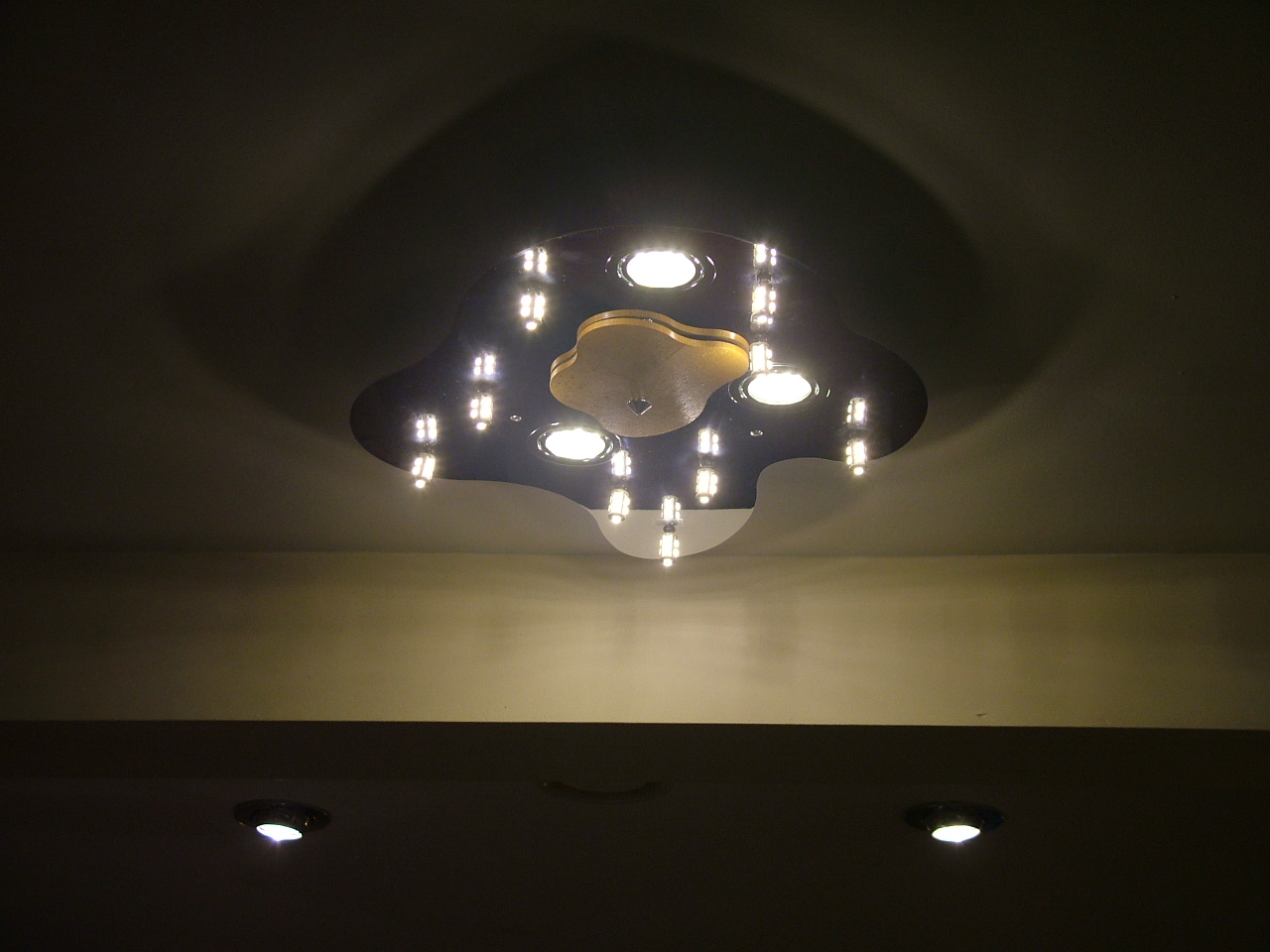
However, the room's main illumination is a mirrored cluster of 10 watt and 20 watt halogen bulbs, totalling 150 watts. The power supply in this lamp recently burned out, giving me the opportunity to replace it with a suitable LED driver and to fit warm white LED lamps and G4 bulbs in place of the halogens. I purchased these from http://www.ledcentre.uk.com/ and they were delivered the next day - in the middle of the pre-Christmas rush.
The chrome lamp units have a really high quality feel and I am amazed that the light they provide is simply BETTER than the illumination we got from the halogen bulbs they have replaced. What is more surprising is the feeling of warmth that this bright light creates. The mirrored cluster has 12 light fittings and the whole thing now uses the same amount of electricity that a single one of the halogen bulbs used to consume! I have bought another three of these lamp units, to convert the bathroom lights from 60 watt halogen to 7 watt LED.
I worked really hard to cut my home's carbon emissions by 10% last year, to deliver my 10:10 promise, but the bitterly cold weather scuppered this for me. This year's mild winter has enabled me to reduce my home's CO2 by more than 20% which more than makes up for missing last year's target. The effects of warm weather and more efficient use of electricity have combined to save almost a Tonne of CO2 emissions from our home's energy usage in 2011 (3.6 Tonnes), compared with 2010 (4.6 Tonnes).
Monday, 19 December 2011
Wednesday, 31 August 2011
Why my (or your) carbon footprint matters
At the Ashden Awards in June, I was lucky enough to meet Emma Murphy, one of the founders of the green PR outfit, Life Size Media. She combines great technical understanding of climate change mitigation with a creative flair for communicating the subject. I mention this because they are now running a poll on the question, "Do you think it's important to know your carbon footprint?" Quite apart from the audience selection bias of their followers, I suspect that very few people have a clear idea of their own carbon footprint and almost nobody can be sure of their own direct and indirect contribution to humanity's greenhouse gas emissions, the scale of which is illustrated beautifully by a post on Karina Rubiera's blog:
Here are some of the confusing carbon emissions measurements that I have come across today:
1) My local leisure centre used 6 million kWh of gas last year and its carbon emissions were almost 1500 Tonnes CO2e. I go there once every few months: how much of that carbon footprint has my name on it?
2) The local boys' secondary school, that my son and I both attended and where my wife is a governor, had publicly reported emissions of 984 Tonnes CO2e in 2008.
3) Intensively reared lamb in the USA causes CO2-equivalent emissions of almost 40kg for every kilo of meat. Some of this is due to methane emissions from the ruminant gut but much is due to the agricultural feedstock: lamb raised on hill-farms in Britain would, quite literally, embody much less carbon emissions than their grain-reared cousins imprisoned in American feedlots.
4) Duncan Clark, of 10:10 and the Guardian, has reflected deeply on the question of short-haul flights in his blog post today. He concludes that our personal carbon emissions matter much less than the effect that our awareness-raising can have on those of others.
Of course, I agree that communication and awareness-raising are at the heart of the matter. Duncan and Emma are both leading exponents of sustainability communications and yet even they, I think they would agree, have limited ability to reach out to the wider public, at home and abroad, and engage them in the battle against dangerous climate change due to fossil carbon emissions from unsustainable behaviours and practices in so many aspects of our contemporary lifestyles. The clamour of commercial concerns, urging us to consume and spend so that they can grow and profit, is usually too loud and incessant for quiet voices of restraint and reflection to be heard.
This is one reason why I think it matters that each of us considers our own carbon footprint and makes sure to reduce it over time. If you will excuse the clumsy analogy, it's the ethical equivalent of a medical thermometer for my environmental conscience. The 10:10 campaign grabbed the attention of 100,000 people last year, along with 1000s of businesses and institutions, and focused them on the challenge of cutting their carbon emissions by 10% in 2010. Positive, purposeful progress - what an amazing achievement! It's still full steam ahead for the good ship 10:10 and their challenge to each of us now is to cut 10% every year.
However, it's not enough to know the amount of indirect emissions that feature in my personal carbon account simply for being a citizen - including healthcare, education, defence, government, transport and other infrastructure. I cannot influence these through my own efforts. The direct carbon impacts of my activities and decisions are much more important to me in measuring my personal responsibility for human-induced climate change. I want to know, and reduce, the carbon footprint of my personal consumption - such as transport, diet, shopping, entertainment and home energy use.
Useful books and online tools abound to help me know my numbers but, where possible, I favour direct measurement. It's simple, accurate and reflects my improvements every year. At home, just put regular meter readings into a basic spreadsheet and, with a couple of standard conversion factors, you can see directly what progress you are making towards cutting your carbon year on year. This graph shows our home's total energy use for the calendar years 2009 -11.
The next one is smoothed using Moving Annual Totals (MAT) for electricity and gas use, and carbon emissions, over the same period. You can see that the green line has been bumping along just above 4 Tonnes/year CO2 emissions since May 2011: by contrast, our home energy use in 2006 emitted more than 8 Tonnes CO2.
These direct measurements and graphs are not to everyone's taste but they motivate me to remain focused on our home's energy use. If you don't want to make your own spreadsheet, Oxford University's Environmental Change Institute (ECI) have already done it for you! Just sign up to iMeasure and they'll prompt you to type in your meter readings every Monday. Over time, iMeasure shows you your home's energy consumption, and its carbon footprint, in a variety of ways. The two features that I find most impressive are the weekly energy performance rating (A-G) that it gives your home and the rolling competition with neighbours in our local Carbon Club - we're nothing if not competitive!
Similarly, I keep a little logbook in the driver's door pocket of my car, to record my fuel consumption. I multiply the litres of diesel purchased by 2.68 (kg CO2 per litre) to calculate my direct driving emissions. I have to make some estimates for maintenance and embodied emissions in the car's manufacture: these last go down for every additional year that I keep the car on the road but do they offset the direct emissions from a newer, more efficient vehicle? Mike Berners-Lee wrote this excellent piece in the Guardian, from his book, "How Bad Are Bananas?". There was also a great decision tree for keeping or replacing an older car - I'll post a link if I can find one.
For travel by public transport, eating, reading, holidays, gadgets, etc., the Guardian's quick carbon calculator, posted by Duncan Clark in 2009 and created by Small World Consulting, is the best footprint calculator I know.
To sum up, I think it does matter that we each care about our individual carbon footprint, gain some idea of its size and become engaged in whittling it down over time. It's not going to stop dangerous, manmade climate change in its tracks but it is an ethical, personal response to the moral challenge of treading lightly on the Earth and the living world that we continue to share it with.
Here are some of the confusing carbon emissions measurements that I have come across today:
1) My local leisure centre used 6 million kWh of gas last year and its carbon emissions were almost 1500 Tonnes CO2e. I go there once every few months: how much of that carbon footprint has my name on it?
2) The local boys' secondary school, that my son and I both attended and where my wife is a governor, had publicly reported emissions of 984 Tonnes CO2e in 2008.
3) Intensively reared lamb in the USA causes CO2-equivalent emissions of almost 40kg for every kilo of meat. Some of this is due to methane emissions from the ruminant gut but much is due to the agricultural feedstock: lamb raised on hill-farms in Britain would, quite literally, embody much less carbon emissions than their grain-reared cousins imprisoned in American feedlots.
4) Duncan Clark, of 10:10 and the Guardian, has reflected deeply on the question of short-haul flights in his blog post today. He concludes that our personal carbon emissions matter much less than the effect that our awareness-raising can have on those of others.
Of course, I agree that communication and awareness-raising are at the heart of the matter. Duncan and Emma are both leading exponents of sustainability communications and yet even they, I think they would agree, have limited ability to reach out to the wider public, at home and abroad, and engage them in the battle against dangerous climate change due to fossil carbon emissions from unsustainable behaviours and practices in so many aspects of our contemporary lifestyles. The clamour of commercial concerns, urging us to consume and spend so that they can grow and profit, is usually too loud and incessant for quiet voices of restraint and reflection to be heard.
This is one reason why I think it matters that each of us considers our own carbon footprint and makes sure to reduce it over time. If you will excuse the clumsy analogy, it's the ethical equivalent of a medical thermometer for my environmental conscience. The 10:10 campaign grabbed the attention of 100,000 people last year, along with 1000s of businesses and institutions, and focused them on the challenge of cutting their carbon emissions by 10% in 2010. Positive, purposeful progress - what an amazing achievement! It's still full steam ahead for the good ship 10:10 and their challenge to each of us now is to cut 10% every year.
However, it's not enough to know the amount of indirect emissions that feature in my personal carbon account simply for being a citizen - including healthcare, education, defence, government, transport and other infrastructure. I cannot influence these through my own efforts. The direct carbon impacts of my activities and decisions are much more important to me in measuring my personal responsibility for human-induced climate change. I want to know, and reduce, the carbon footprint of my personal consumption - such as transport, diet, shopping, entertainment and home energy use.
Useful books and online tools abound to help me know my numbers but, where possible, I favour direct measurement. It's simple, accurate and reflects my improvements every year. At home, just put regular meter readings into a basic spreadsheet and, with a couple of standard conversion factors, you can see directly what progress you are making towards cutting your carbon year on year. This graph shows our home's total energy use for the calendar years 2009 -11.
The next one is smoothed using Moving Annual Totals (MAT) for electricity and gas use, and carbon emissions, over the same period. You can see that the green line has been bumping along just above 4 Tonnes/year CO2 emissions since May 2011: by contrast, our home energy use in 2006 emitted more than 8 Tonnes CO2.
These direct measurements and graphs are not to everyone's taste but they motivate me to remain focused on our home's energy use. If you don't want to make your own spreadsheet, Oxford University's Environmental Change Institute (ECI) have already done it for you! Just sign up to iMeasure and they'll prompt you to type in your meter readings every Monday. Over time, iMeasure shows you your home's energy consumption, and its carbon footprint, in a variety of ways. The two features that I find most impressive are the weekly energy performance rating (A-G) that it gives your home and the rolling competition with neighbours in our local Carbon Club - we're nothing if not competitive!
Similarly, I keep a little logbook in the driver's door pocket of my car, to record my fuel consumption. I multiply the litres of diesel purchased by 2.68 (kg CO2 per litre) to calculate my direct driving emissions. I have to make some estimates for maintenance and embodied emissions in the car's manufacture: these last go down for every additional year that I keep the car on the road but do they offset the direct emissions from a newer, more efficient vehicle? Mike Berners-Lee wrote this excellent piece in the Guardian, from his book, "How Bad Are Bananas?". There was also a great decision tree for keeping or replacing an older car - I'll post a link if I can find one.
For travel by public transport, eating, reading, holidays, gadgets, etc., the Guardian's quick carbon calculator, posted by Duncan Clark in 2009 and created by Small World Consulting, is the best footprint calculator I know.
To sum up, I think it does matter that we each care about our individual carbon footprint, gain some idea of its size and become engaged in whittling it down over time. It's not going to stop dangerous, manmade climate change in its tracks but it is an ethical, personal response to the moral challenge of treading lightly on the Earth and the living world that we continue to share it with.
Monday, 15 August 2011
A sustainable summer
A summer to remember! The joy of rail. The beauty of Italian cities. The weak pound. Endless blackberries.
We haven't flown abroad on holiday for several years, for rather obvious environmental reasons, yet we love the experience of European travel and are loathe to give up our annual immersion in other languages, cultures, climate and cuisine. This year, despite the poor exchange rate, we decided to travel to Italy for our summer holiday, to see places we haven't seen before and to give our 16-year old daughter a more memorable European experience. We invested plenty of time up front in planning our itinerary and accommodation, so that we could book the right trains on Rail Europe as soon as they became available, 3 months before travel. All our plans bore fruit, every train throughout the holiday ran on time and we loved the adventure of watching countryside, seas and mountains from our panoramic windows. Our hotels in Paris, Rome and Venice were all well situated for exploring these great cities on foot and by underground or river bus. Our most relaxing break was in an apartment overlooking the small village of Argegno, on the shore of Lake Como, which we reached by ferry and bus.
Last year, the carbon emissions from our family of four travelling to the Tarn region of southwest France and back, by car and cross-channel ferry*, were around 670 kg - or 170 kg CO2 per head. According to Best Foot Forward, in their study commissioned by Rail Europe, the equivalent emissions for this year's holiday by rail for the three of us were about 135 kg - a mere 45 kg CO2 per head. Conversely, if three of us had flown to Rome and back, our journey's climate change impact (including radiative forcing, due to the altitude of the plane's emissions) would have been 1,660 kg - or 550 kg CO2 per head, according to the Carbon Footprint calculator.
So, a European family holiday by train results in less than a tenth of the carbon emissions of the same holiday by plane. The same holiday by car results in 3-4 times the emissions of the train but only a third of the plane.
Scaling this up, I have just returned from a fabulous week at Scout camp in Belgium. 22 of us travelled by Eurostar and 5 leaders took our kit across in a car and a van. The GHG emissions from our 22 return rail journeys were just 57 kg CO2, the same as those from one single passenger making the same trip by plane! Adding in the car and van journeys (475 kg CO2*) gives a carbon footprint, for 27 of us and our kit travelling to and from camp, totalling 530 kg - only 20 kg CO2 per person.
And the blackberries? I'm not talking about the rioters' social medium of choice but rather the extended harvest of wild fruit we have enjoyed this summer. Spurred on by the hot, dry spring, all our apples, blackberries and other wild food are offering a prolonged and bountiful harvest of succulent fruit. Even the mushrooms seem to be coming out early this year - if you know what to collect and eat safely, you are in for an outstanding season of delicious, free food!
* Modern cross-channel ferries emit around 8kg per passenger (return journey), according to the Best Foot Forward study reported on the SeaFrance website. I have included this amount in all the driving calculations shown in this post.
We haven't flown abroad on holiday for several years, for rather obvious environmental reasons, yet we love the experience of European travel and are loathe to give up our annual immersion in other languages, cultures, climate and cuisine. This year, despite the poor exchange rate, we decided to travel to Italy for our summer holiday, to see places we haven't seen before and to give our 16-year old daughter a more memorable European experience. We invested plenty of time up front in planning our itinerary and accommodation, so that we could book the right trains on Rail Europe as soon as they became available, 3 months before travel. All our plans bore fruit, every train throughout the holiday ran on time and we loved the adventure of watching countryside, seas and mountains from our panoramic windows. Our hotels in Paris, Rome and Venice were all well situated for exploring these great cities on foot and by underground or river bus. Our most relaxing break was in an apartment overlooking the small village of Argegno, on the shore of Lake Como, which we reached by ferry and bus.
Last year, the carbon emissions from our family of four travelling to the Tarn region of southwest France and back, by car and cross-channel ferry*, were around 670 kg - or 170 kg CO2 per head. According to Best Foot Forward, in their study commissioned by Rail Europe, the equivalent emissions for this year's holiday by rail for the three of us were about 135 kg - a mere 45 kg CO2 per head. Conversely, if three of us had flown to Rome and back, our journey's climate change impact (including radiative forcing, due to the altitude of the plane's emissions) would have been 1,660 kg - or 550 kg CO2 per head, according to the Carbon Footprint calculator.
So, a European family holiday by train results in less than a tenth of the carbon emissions of the same holiday by plane. The same holiday by car results in 3-4 times the emissions of the train but only a third of the plane.
Scaling this up, I have just returned from a fabulous week at Scout camp in Belgium. 22 of us travelled by Eurostar and 5 leaders took our kit across in a car and a van. The GHG emissions from our 22 return rail journeys were just 57 kg CO2, the same as those from one single passenger making the same trip by plane! Adding in the car and van journeys (475 kg CO2*) gives a carbon footprint, for 27 of us and our kit travelling to and from camp, totalling 530 kg - only 20 kg CO2 per person.
And the blackberries? I'm not talking about the rioters' social medium of choice but rather the extended harvest of wild fruit we have enjoyed this summer. Spurred on by the hot, dry spring, all our apples, blackberries and other wild food are offering a prolonged and bountiful harvest of succulent fruit. Even the mushrooms seem to be coming out early this year - if you know what to collect and eat safely, you are in for an outstanding season of delicious, free food!
* Modern cross-channel ferries emit around 8kg per passenger (return journey), according to the Best Foot Forward study reported on the SeaFrance website. I have included this amount in all the driving calculations shown in this post.
Labels:
blackberries,
carbon footprint,
Rail Europe,
SeaFrance,
wild food
Monday, 27 June 2011
Inspiring Energy Events
The annual Ashden Awards for sustainable energy enterprises were presented in London this month and I was lucky enough to be able to join their seminar at the Royal Geographical Society. The morning session, chaired by Jonathan Porritt, focused on UK projects and the international session in the afternoon was chaired by the Guardian editor, Madeline Bunting. During each session, the five finalists in their category screened a film summarising their project's achievements and the representative of the organisation gave a short speech about their work. In the case of the UK finallists, this was posited as an "elevator pitch" to Chris Huhne and David Cameron, to persuade them what needs to be done to make Britain a great place to invest in sustainable energy technologies.
The films themselves are one of the Ashden Awards greatest achievements. I look forward to screening them to the right audiences when the opportunities arise but you can view them yourself on the Ashden Awards website, for both the UK and international finalists.
After the films and pitches, the Chairs facilitated a couple of really useful discussion of pertinent issues - in the case of the international session, Local Clean Energy for the Poor. This brought in technologists, regulators and investors and considered some of the artificial obstacles raised by institutional backers, aiming to verify the outcomes achieved with their support. This discussion also highlighted the merits of grid vs. off-grid energy systems, with all parties agreeing that mini-grids, as seen in Peru and Ecuador, are often the best way to bring efficient, low carbon energy to poor rural communities.
As in previous years, I was greatly inspired by the overseas projects, which seem to exemplify courage and creativity in meeting the needs of - literally - billions of under-served people in the developing world. I was privileged to chat at length with Suraj Wahab Olugburo, the founder of Toyola Energy Ltd of Ghana, who explained his elegant business model that provides work and income for over 500 entrepreneurs in making and selling the Toyola stove, which allows families to cook on half the charcoal needed for traditional stoves. His simple credit scheme allows the local sales agent to give the stove to a family, with a collecting tin: each day that the customer does NOT need to pay for charcoal (because the stove halves their usage), they put their charcoal money into the tin. After a few months, they have saved enough to pay for the stove!
The UK projects were also an inspiration this year and I was delighted to learn that one of the finallists, Radian Housing, was about to open a flagship project in Windsor, where they have built 9 new houses in Tinkers Lane - one is Code 6 (essentially zero carbon) and the others are all Code 5 dwellings, which are highly efficient in the way they use energy. I was delighted to attend the opening ceremony last week, where our Mayor cut the ribbon and some of the residents opened their new homes to all the visitors. We were a distinctly non-technical audience and the main take-home message was that these houses are very attractive, liveable homes that require no special skills from their residents. Sure, some behaviours can be learned (for example, with a huge solar PV power station on the roof, it's worth running the washing machine when the sun is shining) but all the buildings' clean technologies simply run themselves itself without placing any responsibilities on the household.
It was a great pleasure to learn that these two finallists, Toyola and Radian, received the two Gold Awards at the Ashden Awards ceremony, on the evening of the day after the conference.
The other inspiring energy event that I have attended this month was, surprisingly, the RBWM Sustainability Panel at the Town Hall in Maidenhead. After a slow start, discussion moved to the Government's disclosure requirements for greenhouse gas emissions. The responsible officer outlined the framework of Scope I, Scope II and Scope III reporting but focused on the costs and complexity of data-gathering and analysis. The councillors set a different pace, however, reminding the panel that residents expect leadership from their council and that time is of the essence in moving to meaningful reporting of these GHG emissions. This decision was passed unanimously. Good on them!
The same tone was maintained when considering energy reporting, with annual overviews by invoice described as insufficient and unsatisfactory. The vice-chair, Councillor Sharp, called for electricity and gas usage by site to be reported "at least monthly". On Energy Action Plans, the Chairman called for focus on the significant few actions, to make real progress. Lastly, proposals for solar photovoltaic installations up to 50kWp on council buildings were reviewed and the vice-chair, Cllr. Sharp, now well into his stride, said, "We must do it now. Must do it now!" The Chairman concurred, saying "We want it and we want it tomorrow."
Having sat through a few of the previous administration's Sustainability Panels, which I felt were typically bogged down in politics, I found the new council's can-do mentality so empowering. In the closing words of the Chairman, Cllr. David Coppinger, it's time to move from talking to doing. Amen to that.
The films themselves are one of the Ashden Awards greatest achievements. I look forward to screening them to the right audiences when the opportunities arise but you can view them yourself on the Ashden Awards website, for both the UK and international finalists.
After the films and pitches, the Chairs facilitated a couple of really useful discussion of pertinent issues - in the case of the international session, Local Clean Energy for the Poor. This brought in technologists, regulators and investors and considered some of the artificial obstacles raised by institutional backers, aiming to verify the outcomes achieved with their support. This discussion also highlighted the merits of grid vs. off-grid energy systems, with all parties agreeing that mini-grids, as seen in Peru and Ecuador, are often the best way to bring efficient, low carbon energy to poor rural communities.
As in previous years, I was greatly inspired by the overseas projects, which seem to exemplify courage and creativity in meeting the needs of - literally - billions of under-served people in the developing world. I was privileged to chat at length with Suraj Wahab Olugburo, the founder of Toyola Energy Ltd of Ghana, who explained his elegant business model that provides work and income for over 500 entrepreneurs in making and selling the Toyola stove, which allows families to cook on half the charcoal needed for traditional stoves. His simple credit scheme allows the local sales agent to give the stove to a family, with a collecting tin: each day that the customer does NOT need to pay for charcoal (because the stove halves their usage), they put their charcoal money into the tin. After a few months, they have saved enough to pay for the stove!
The UK projects were also an inspiration this year and I was delighted to learn that one of the finallists, Radian Housing, was about to open a flagship project in Windsor, where they have built 9 new houses in Tinkers Lane - one is Code 6 (essentially zero carbon) and the others are all Code 5 dwellings, which are highly efficient in the way they use energy. I was delighted to attend the opening ceremony last week, where our Mayor cut the ribbon and some of the residents opened their new homes to all the visitors. We were a distinctly non-technical audience and the main take-home message was that these houses are very attractive, liveable homes that require no special skills from their residents. Sure, some behaviours can be learned (for example, with a huge solar PV power station on the roof, it's worth running the washing machine when the sun is shining) but all the buildings' clean technologies simply run themselves itself without placing any responsibilities on the household.
It was a great pleasure to learn that these two finallists, Toyola and Radian, received the two Gold Awards at the Ashden Awards ceremony, on the evening of the day after the conference.
The other inspiring energy event that I have attended this month was, surprisingly, the RBWM Sustainability Panel at the Town Hall in Maidenhead. After a slow start, discussion moved to the Government's disclosure requirements for greenhouse gas emissions. The responsible officer outlined the framework of Scope I, Scope II and Scope III reporting but focused on the costs and complexity of data-gathering and analysis. The councillors set a different pace, however, reminding the panel that residents expect leadership from their council and that time is of the essence in moving to meaningful reporting of these GHG emissions. This decision was passed unanimously. Good on them!
The same tone was maintained when considering energy reporting, with annual overviews by invoice described as insufficient and unsatisfactory. The vice-chair, Councillor Sharp, called for electricity and gas usage by site to be reported "at least monthly". On Energy Action Plans, the Chairman called for focus on the significant few actions, to make real progress. Lastly, proposals for solar photovoltaic installations up to 50kWp on council buildings were reviewed and the vice-chair, Cllr. Sharp, now well into his stride, said, "We must do it now. Must do it now!" The Chairman concurred, saying "We want it and we want it tomorrow."
Having sat through a few of the previous administration's Sustainability Panels, which I felt were typically bogged down in politics, I found the new council's can-do mentality so empowering. In the closing words of the Chairman, Cllr. David Coppinger, it's time to move from talking to doing. Amen to that.
Labels:
Ashden Awards,
emissions reporting,
Jonathan Porritt,
Madeline Bunting,
Radian,
RBWM,
Toyola
Sunday, 29 May 2011
A change is brewing
Last week, our Bosch kettle died. We bought it in March 2009, 26 months ago, with a 24 month warranty. I stripped it down but could not get close enough to the sealed electronics to to find the fault. It just blows the 13A fuse in the plug every time we switch it on. I called Bosch customer service, to find out what could be done. They told me to send it back to their workshop, with a cheque for £9, and they would investigate the fault and let me know what needed to be done to repair the kettle. I might just do that, to see if we can keep this otherwise high quality appliance in service rather than having to recycle it. However, I can't imagine that many people would be prepared to throw good money after bad to prolong the life of stuff that has become essentially disposable.
In the meantime, we need a kettle. Making tea and coffee with a saucepan is all very well on the odd occasion, such as a power cut, but we're all used to brewing up a hot drink in a matter of minutes. I have been trying to track down an old-fashioned kettle with a heat exchanger skirt, for use on our gas hob. My Grandma used to have a Simplex kettle like this and I found the company's website but there has been no response so far from their Contact Form.
I'm fairly clear, however, that the rest of the family won't tolerate life without an electric kettle that switches itself off when it comes to the boil. I have long been fascinated with the Eco Kettle, which combines an onboard water reservoir with a clearly-calibrated boiling chamber, designed to make it consummately easy to boil only the amount of water that you need. I decided to get one from Ecotopia, because they offered the best price and the fastest service, and I was pleasantly surprised to take delivery of a chrome Eco Kettle 2 the following day.
Having lived with the new gadget for a couple of days, I am happy with almost all aspects of its performance. It's very quiet because it uses a less powerful element than most ordinary kettles. This makes no appreciable difference to boiling times for one or two cups but must take slightly longer than a regular kettle to boil a teapotful, I suppose. It's certainly heavy because it's carrying a full tank of water even when you're just boiling one cup. However, the weight is not a problem for my family and the Eco Kettle is very well balanced and pours cleanly. It also lives up to its promise, making it truly effortless to boil just the amount you need.
The one thing that makes no sense is that the kettle is terribly slow to switch off, once the water has boiled. The power stays on for more than 10 seconds after the water can be seen and heard to be boiling vigorously. When boiling a full charge of water, the EcoKettle moves around violently and seems ready to jump off its base. It hasn't actually spilled any boiling water yet but it seems likely that this aspect of the design needs to be refined, so that the Eco Kettle doesn't waste electricity raising steam while the boil detector makes up its mind to turn the power off. More importantly, any possibility of scalding from spitting liquid or even a spilt kettle is a serious safety issue. I'll share my concern with the manufacturer and report back any response that they offer.
In the meantime, we need a kettle. Making tea and coffee with a saucepan is all very well on the odd occasion, such as a power cut, but we're all used to brewing up a hot drink in a matter of minutes. I have been trying to track down an old-fashioned kettle with a heat exchanger skirt, for use on our gas hob. My Grandma used to have a Simplex kettle like this and I found the company's website but there has been no response so far from their Contact Form.
I'm fairly clear, however, that the rest of the family won't tolerate life without an electric kettle that switches itself off when it comes to the boil. I have long been fascinated with the Eco Kettle, which combines an onboard water reservoir with a clearly-calibrated boiling chamber, designed to make it consummately easy to boil only the amount of water that you need. I decided to get one from Ecotopia, because they offered the best price and the fastest service, and I was pleasantly surprised to take delivery of a chrome Eco Kettle 2 the following day.
Having lived with the new gadget for a couple of days, I am happy with almost all aspects of its performance. It's very quiet because it uses a less powerful element than most ordinary kettles. This makes no appreciable difference to boiling times for one or two cups but must take slightly longer than a regular kettle to boil a teapotful, I suppose. It's certainly heavy because it's carrying a full tank of water even when you're just boiling one cup. However, the weight is not a problem for my family and the Eco Kettle is very well balanced and pours cleanly. It also lives up to its promise, making it truly effortless to boil just the amount you need.
The one thing that makes no sense is that the kettle is terribly slow to switch off, once the water has boiled. The power stays on for more than 10 seconds after the water can be seen and heard to be boiling vigorously. When boiling a full charge of water, the EcoKettle moves around violently and seems ready to jump off its base. It hasn't actually spilled any boiling water yet but it seems likely that this aspect of the design needs to be refined, so that the Eco Kettle doesn't waste electricity raising steam while the boil detector makes up its mind to turn the power off. More importantly, any possibility of scalding from spitting liquid or even a spilt kettle is a serious safety issue. I'll share my concern with the manufacturer and report back any response that they offer.
Monday, 9 May 2011
Simple Energy Saving at home
I was very pleased that Julian Worricker read out my email in full on Radio 4's "You & Yours" programme today. You can Listen Again on iPlayer here, until Monday 16 May - around 46 minutes in. Here's what I sent into the programme:
Of course, I couldn't provide the evidence behind this on the programme, so I will do this here. I was also struck by Julian's response: he said, "That's very positive from his point of view but we don't all have the time to do that". Accepting this viewpoint, the challenge is to make it so easy for people to use energy wisely in their homes that they find it only natural to cut waste and save money on their bills.
In 2006, our home used 30,400 kWh of energy: 21,200 units of gas and 9,200 of electricity. This cost almost £1500. Since then I have invested in great tranches of loft insulation, all shapes and sizes of energy-saving light bulbs, a condensing boiler, a solar thermal panel (the boiler has been off for weeks now), an efficient larder fridge and the 8 watt Fit-PC computer (strictly a net-top) that I am writing this blog on now. We have also pulled together as a family to change our behaviour, switching everything off at the mains when not needed, keeping the thermostat down low in the winter and generally striving to avoid wasting energy.
2010 was an unusual year, starting and ending with prolonged spells of extreme cold. As a result, our 2010 energy use was greater than expected. However, 2011 has been unseasonably warm so far and our energy consumption since January has been 20% lower than the same period last year. In the past 12 months, we have used a total of 17,200 kWh at home: 12,800 units of gas and 4,400 kWh of electricity. This graph shows our annual energy costs, for gas and electricity, over the past five years. I've also included my estimate for 2011 and we are on track to spend just £1000 on home energy this year:
The point of all this data is to make clear the savings to be had by using energy wisely. If my family's power consumption had remained at 2006 levels, we would now be paying over £1,700 a year for our gas and electricity. On the news today, Centrica warned that forward gas prices for next winter are 25% higher than they were at this time last year. This makes it apparent that everyone's energy bills will rise - unless they act to reduce their usage! The investments needed are one-off costs but the payback comes ever after - in my case, a saving of £60 a month on the cost of home energy. The higher the price, the bigger the saving. What's stopping you, Julian?
"It's worth all the effort to insulate, switch off and replace inefficient bulbs and appliances. I have managed to cut my family's home electricity use in half, and our gas consumption by a third, since 2006. The cost of insulation, light bulbs and an A+ refrigerator were quickly paid back and my energy bills are a third lower now than they were in 2006."
In 2006, our home used 30,400 kWh of energy: 21,200 units of gas and 9,200 of electricity. This cost almost £1500. Since then I have invested in great tranches of loft insulation, all shapes and sizes of energy-saving light bulbs, a condensing boiler, a solar thermal panel (the boiler has been off for weeks now), an efficient larder fridge and the 8 watt Fit-PC computer (strictly a net-top) that I am writing this blog on now. We have also pulled together as a family to change our behaviour, switching everything off at the mains when not needed, keeping the thermostat down low in the winter and generally striving to avoid wasting energy.
2010 was an unusual year, starting and ending with prolonged spells of extreme cold. As a result, our 2010 energy use was greater than expected. However, 2011 has been unseasonably warm so far and our energy consumption since January has been 20% lower than the same period last year. In the past 12 months, we have used a total of 17,200 kWh at home: 12,800 units of gas and 4,400 kWh of electricity. This graph shows our annual energy costs, for gas and electricity, over the past five years. I've also included my estimate for 2011 and we are on track to spend just £1000 on home energy this year:
The point of all this data is to make clear the savings to be had by using energy wisely. If my family's power consumption had remained at 2006 levels, we would now be paying over £1,700 a year for our gas and electricity. On the news today, Centrica warned that forward gas prices for next winter are 25% higher than they were at this time last year. This makes it apparent that everyone's energy bills will rise - unless they act to reduce their usage! The investments needed are one-off costs but the payback comes ever after - in my case, a saving of £60 a month on the cost of home energy. The higher the price, the bigger the saving. What's stopping you, Julian?
Wednesday, 27 April 2011
Let's recycle more!
We have had kerbside recycling in Windsor for quite a few years. Several years ago, I learned that our local authority, the Royal Borough of Windsor and Maidenhead, won't accept mixed plastics (ie., plastic food packaging other than bottles) for recycling. At this point I took Greenpeace's advice and started to clean and collect my family's own mixed plastic packaging (yoghurt pots, margarine tubs, ready meal trays, fruit punnets, etc) in anticipation of future recycling services. My collection of mixed plastics has featured prominently in the local paper and was also used artistically last year, to make a "10%" sign in front of Windsor Castle, in support of the Global Day of Doing on 10 October 2010 (10/10/10).
Other Boroughs across the country now collect mixed plastic - the latest to announce this service is the neighbouring Woking Borough Council, who have a contract with Biffa to recycle all types of plastic (other than bags and films) within their domestic, co-mingled kerbside collection. Biffa have acquired Greenstar WES and their new mixed plastics recycling facility, opened this month in Redcar, will be able to sort and bale 20,000 Tonnes of mixed plastics each year.
Closer to home, this morning Neil Grundon (a founder member of our Sustainable Windsor group) showed me around Grundon's materials recovery facility (MRF) in Colnbrook. They are able to sort and bale steel and aluminium cans, paper and cardboard, mixed plastics. They also collect glass which is used as aggregate in roadbuilding or for recycling. Grundon recycle household waste from nearby boroughs such as Guildford, Spelthorne and Hillingdon. I took some of my mixed plastic packaging along with me today, to see how well their sorting process coped with it.
I was delighted to see my carefully laundered yoghurt pots and margarine tubs flying along the final conveyor into the mixed plastics silo, ready for baling. Black plastics are hard to sort, at present, because an optical process, near infra-red reflectance (NIR), is used for the sorting. However, these could be separated from the final waste stream in future by an additional sorting machine that is "trained" to work on black plastics.
Recoup, a charity promoting the RECycling Of Used Plastics, publishes an annual report on the collection of plastic packaging from UK Households. In their latest report, RECOUP reports that mixed plastics (ie., rigid plastic packaging other than bottles) are actively recycled by 120 local authorities in the UK, out of 401 that they contacted.
Despite all this progress in the recycling of mixed plastics nationally, the Royal Borough of Windsor and Maidenhead seems to be locked in a recycling time-warp! The Royal Borough's current waste and recycling contractor is Veolia and there is no indication on the Veolia website that they are prepared ever to provide a mixed plastics recycling service to their municipal customers. The waste and recycling contract for Windsor and Maidenhead is up for renewal this year. Clearly Biffa and Grundon are competent, commercial partners who should be allowed to tender for this valuable contract. Will the Council insist on the provision of a wider range of recycling streams from the company that successfully tenders for this valuable contract - or will the business stay with Veolia because they can offer the lowest price?
Other Boroughs across the country now collect mixed plastic - the latest to announce this service is the neighbouring Woking Borough Council, who have a contract with Biffa to recycle all types of plastic (other than bags and films) within their domestic, co-mingled kerbside collection. Biffa have acquired Greenstar WES and their new mixed plastics recycling facility, opened this month in Redcar, will be able to sort and bale 20,000 Tonnes of mixed plastics each year.
Closer to home, this morning Neil Grundon (a founder member of our Sustainable Windsor group) showed me around Grundon's materials recovery facility (MRF) in Colnbrook. They are able to sort and bale steel and aluminium cans, paper and cardboard, mixed plastics. They also collect glass which is used as aggregate in roadbuilding or for recycling. Grundon recycle household waste from nearby boroughs such as Guildford, Spelthorne and Hillingdon. I took some of my mixed plastic packaging along with me today, to see how well their sorting process coped with it.
I was delighted to see my carefully laundered yoghurt pots and margarine tubs flying along the final conveyor into the mixed plastics silo, ready for baling. Black plastics are hard to sort, at present, because an optical process, near infra-red reflectance (NIR), is used for the sorting. However, these could be separated from the final waste stream in future by an additional sorting machine that is "trained" to work on black plastics.
Recoup, a charity promoting the RECycling Of Used Plastics, publishes an annual report on the collection of plastic packaging from UK Households. In their latest report, RECOUP reports that mixed plastics (ie., rigid plastic packaging other than bottles) are actively recycled by 120 local authorities in the UK, out of 401 that they contacted.
Despite all this progress in the recycling of mixed plastics nationally, the Royal Borough of Windsor and Maidenhead seems to be locked in a recycling time-warp! The Royal Borough's current waste and recycling contractor is Veolia and there is no indication on the Veolia website that they are prepared ever to provide a mixed plastics recycling service to their municipal customers. The waste and recycling contract for Windsor and Maidenhead is up for renewal this year. Clearly Biffa and Grundon are competent, commercial partners who should be allowed to tender for this valuable contract. Will the Council insist on the provision of a wider range of recycling streams from the company that successfully tenders for this valuable contract - or will the business stay with Veolia because they can offer the lowest price?
Labels:
Biffa,
Grundon,
mixed plastic packaging,
RBWM,
Veolia,
Woking Borough Council
Subscribe to:
Posts (Atom)